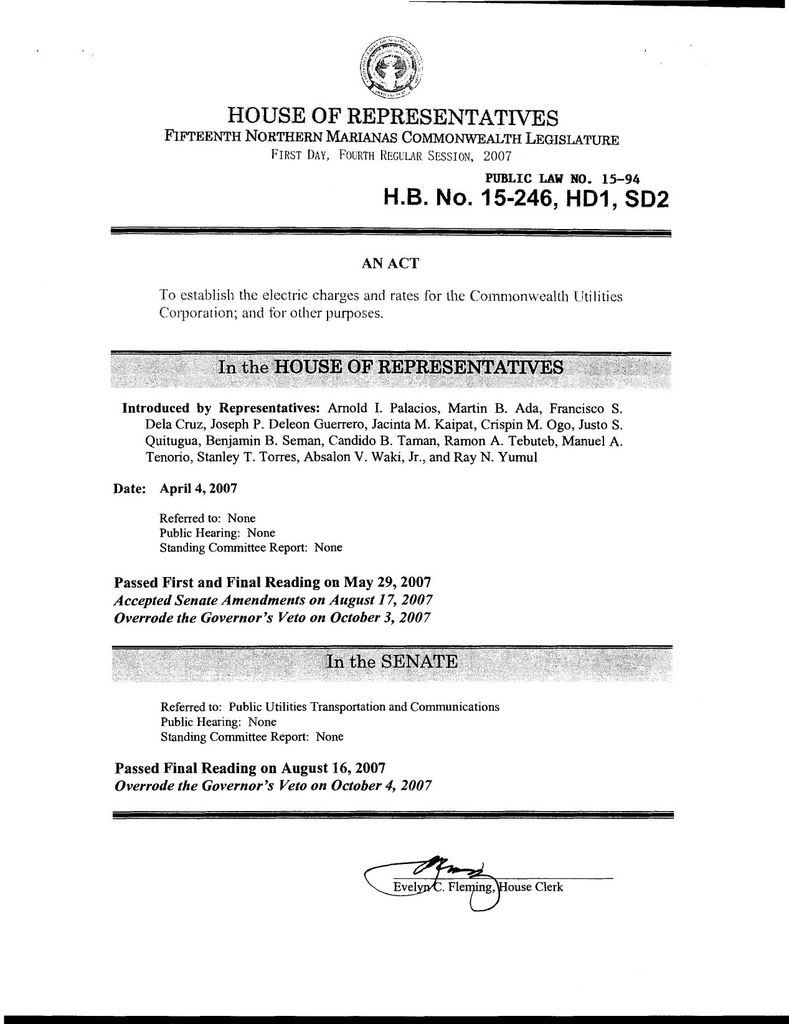
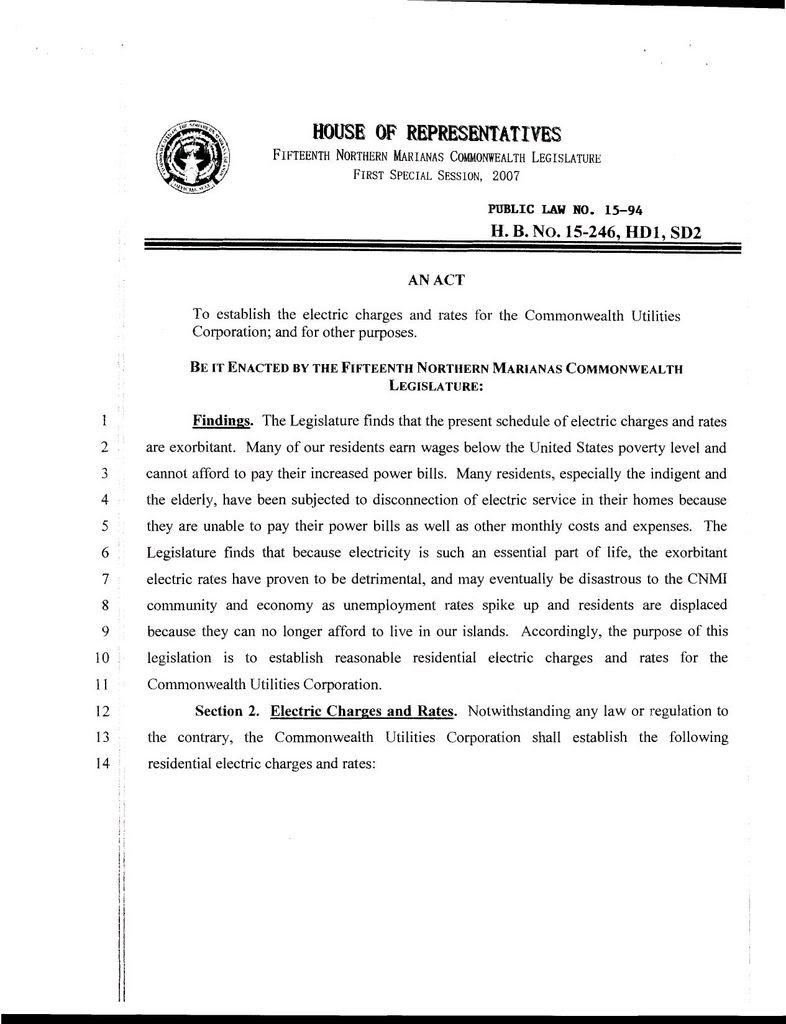
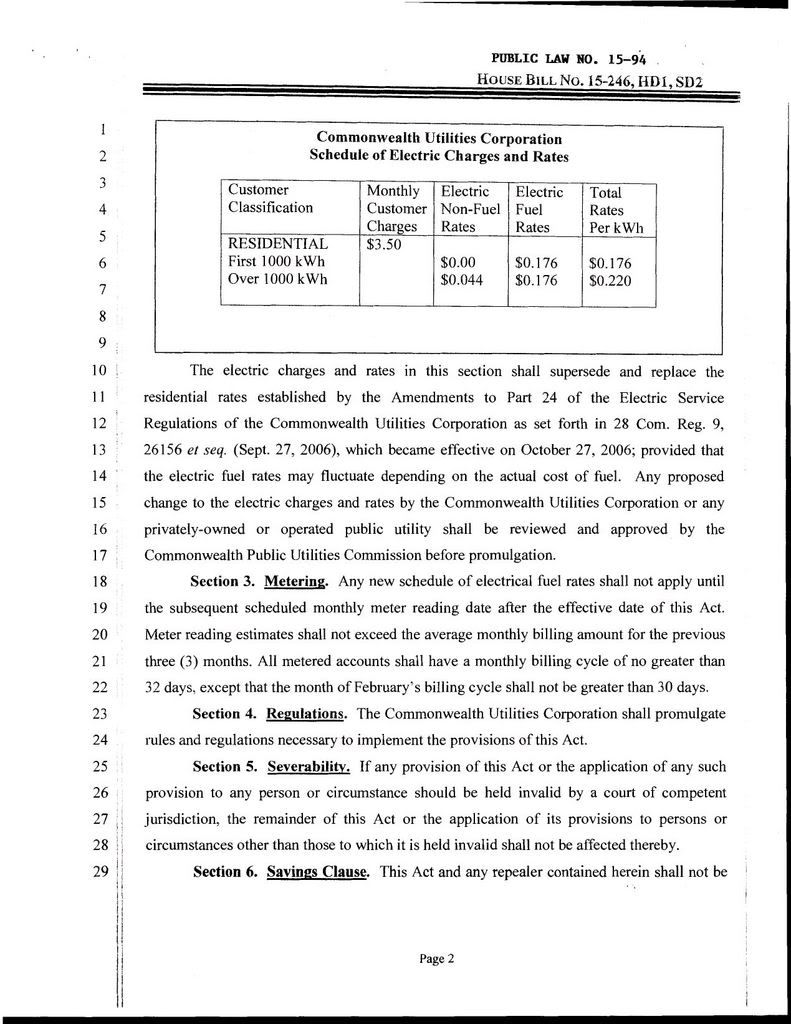
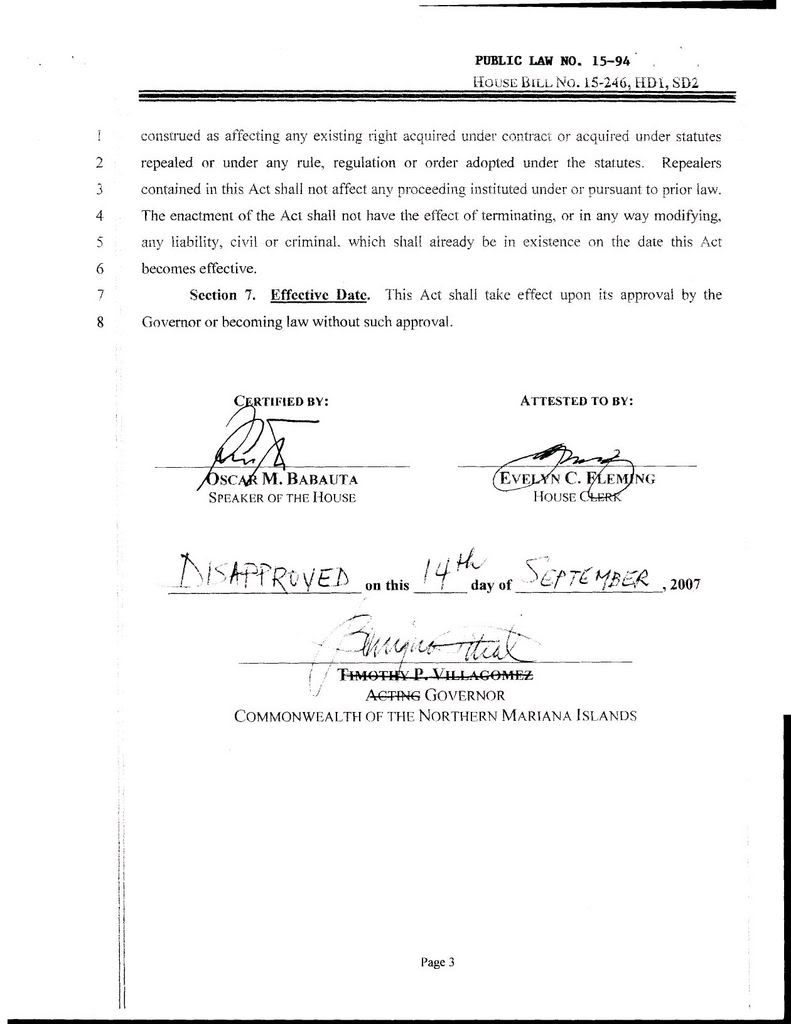
http://www.mvariety.com/?module=displaystory&story_id=9690&format=html
By Raymond A. Martinez
Variety News Staff
THE Commonwealth Utilities Corp. has increased its electric fuel rate this month for its commercial, government, and non-conforming load customers.
Based on CUC’s April schedule of electric charges and rates, the electric fuel rate for commercial, government, and non-conforming load was raised to $0.327 after the cost of fuel per barrel reached $132.
CUC said last month the fuel cost was between $110 and $120 per barrel.
The $0.327 is applied to all kilowatt-hour electric usage of non-residential customers.
Currently, the total rate per kilowatt hour for commercial customers is up from last month’s $0.374 to $0.413.
The total rate per kilowatt hour for government customers is up from $0.379 to $0.418.
The total rate per kilowatt hour for non-conforming load customers is up from $0.510 to $0.549.
Non-conforming load refers to CUC’s Tinian customers which include the International Broadcasting Bureau.
CUC said the monthly charge and the electric non-fuel rate are still fixed at their old amounts.
The electric non-fuel rate for commercial is at 0.086, government at 0.091, and con-conforming load at 0.222.
The electric fuel rate for residential customers still remains at 17.6 cents per kilowatt hour, pursuant to Public Law 15-94 which lowered the ceiling rate of electric fuel from 25.3 cents per kwh.
CUC Executive Director Anthony C. Guerrero earlier said that they were only able to purchase 11,000 barrels of fuel from Mobil due to lack of funds.
CUC could pay only $1.5 million for the fuel delivery, short of 14,000 barrels to operate its power plant facilities for one month.
Press Secretary Charles P. Reyes Jr. said, “We are still addressing the issue. It is a very difficult matter.”
Wednesday, April 9, 2008

Sunday, December 30, 2007
LET US BRING YOU BACK A YEAR!
January 1st, 2006
Power crisis reveals lingering CUC woes
Faced by recurring blackouts stemming from a lack of fuel supply and owing to the Commonwealth Utilities Corp.'s rock bottom cash situation, Gov. Juan N. Babauta declared a state of emergency on utilities during his State of the Commonwealth Address on May 19 this year.While the intention was considered noble-which was to ensure a stable power supply-the governor's declaration was much criticized, especially by the political opposition, since his action attested to the severe financial crisis of the government, on the face of his much-parodied insistence that the state of the Commonwealth was “still pretty darn good.”The declaration lasted not for a month or two but seven whole months, or just weeks before the end of the governor's term. Meantime, immediately following the emergency declaration, which placed the entire CUC under the direct supervision of the governor, the government obtained a commitment from CUC's lone fuel supplier, Mobil Oil Marianas, to deliver a month-long supply of fuel.At the same time, negotiations between the government and Mobil continued for a long-term fuel supply contract.This negotiation, headed by Lt. Gov. Diego T. Benavente and governor's advisor Adam Turner, culminated with the signing of a two-year contract with Mobil in early June 2005, amounting to at least $60 million.Mobil's previous contract with CUC expired on April 30.Due to CUC's pitiful fiscal condition, it could not arrange for another contract with the fuel company by itself.Then CUC executive director Lorraine A. Babauta cited that the rising cost of fuel has taken its toll on CUC, and the governor was needed “to step in and assist in any way possible to make sure that a fuel contract is executed at the earliest possible time.”“That's basically what's been keeping us from moving forward,” the CUC official had said.She cited that CUC fuel costs have risen from $30 million annually to $60 million in 16 months.REPROGRAMMING With the emergency declaration came the reprogramming of funds and the hiring of “consultants” to arrest the power crisis, which was later discovered to be caused not only by the lack of fuel but the neglect and poor maintenance at CUC's power generation plants in Lower Base.From May 19 to October 2005, the governor reported the reprogramming of some $5.1 million in local funds and $2.6 million in federal funds. Later, the governor said that the Marianas Public Lands Authority had also chipped in by reprogramming $1 million for CUC.Recently, CUC reportedly said that it received an additional $1 million from the administration. It was expecting some $500,000 from the administration as of last week.LEGISLATURE OKS REPROGRAMMINGA week after Babauta declared the emergency, the House of Representatives, headed by opposition Speaker Benigno R. Fitial adopted House Joint Resolution 14-36, granting the governor 100 percent authority to reprogram any available local funds to remedy the power crisis.The measure, which was introduced by Fitial himself, also passed the Senate shortly.“The Legislature supports the governor's declaration of state of disaster emergency. It is the intent of the Legislature to authorize the governor 100 percent reprogramming authority from available Commonwealth funds to remedy the power generation problems,” reads part of the resolution.The resolution, however, prohibited the governor from entering into any public debt without the approval of the Legislature, as provided in the CNMI Constitution Article 10, Section 3. This came about after learning that the Executive Branch and CUC entered into a $10-million letter of credit with the Bank of Guam following the May 19 emergency declaration.Babauta said, though, that the standby letter of credit with BoG is not public indebtedness, pointing out that CUC is a semi-public corporation that has its own assets. In the end, the administration said Mobil's new contract incurred no new long-term credit with the bank.It said that the new fuel contract called for a cash guarantee to Mobil of $7.5 million. This guarantee was made by securing CUC funds that were “already in the Bank of Guam” against fuel purchases.Authorities said the CUC has some $9 million in restricted funds at BoG.NEGLECTED GENERATORSAfter the fuel contract was secured, CUC's Lorraine Babauta revealed that the maintenance of engines “also remains a serious issue.”She said in early June that renovation and other improvements on existing engines would cost over $2 million.KUMOI'S CONTRACTExpressing possible abuse of authority under the emergency declaration, the political opposition revealed that CUC had entered into consultancy contracts with former senator and former CUC executive director Ramon “Kumoi” Guerrero and California-based electrical engineer Roger Kitchingham to fix CUC's engines.Initial documents showed that CUC approved a $21,000-purchase order for Guerrero and a $20,000-agreement for Kitchingham for the repair of CUC power plant II, which is adjacent to the main power plant, Power Plant I.Before this, Guerrero had secured a separate $50,000-consultancy contract with the Governor's Office for the La Fiesta complex.The former senator's entry as Babauta's consultant during an election year was put under close watch since he was previously associated with the opposition, particularly with Fitial. “We need to watch carefully to make sure that what is actually done is in the best interest of taxpayers and public utilities, and not patronage or political maneuvering using taxpayers' funds,” Fitial's spokesman, Charles Reyes, had said.But the opposition only had to wait for a little time as Guerrero's power plant consultancy was not for long.On Aug. 1, shortly after finishing his contract or the non-renewal of it, Guerrero was the guest of honor at a House panel's public hearing, lashing out at CUC's “incompetence” in handling the power generation business.Guerrero expressed his anger over Attorney General Pamela Brown's so-called interference, which he said was causing the delay in the repair of engines.The AGO refuted this, alleging that it was Guerrero who tried to manipulate CUC and overlook procurement rules to sole-source contracts.FUEL SURCHARGEThe Legislature, initiated by the House leadership, moved to repeal the fuel surcharge fee, which the CUC had imposed effective March this year on all CUC customers.The measure, House Bill 14-343, authored by Vice Speaker and former CUC executive director Timothy Villagomez, aims to repeal the law, 4 CMC section8148 (b) , which gives the CUC board the authority to impose up to 3.5 cents fuel surcharge per kilowatt hour.Despite public clamor for its repeal, Gov. Babauta vetoed the bill, retaining the fuel surcharge.Before this, the governor asked the Legislature to appropriate funds for CUC if it wants the bill enacted into law. Babauta said that while he sympathized with consumers, he said that removing the fuel surcharge without an alternative fund would mean the collapse of the local utility firm.He challenged the Legislature to appropriate $31 million to let CUC buy fuel to run the power plants in the next 15 months, appropriate funds to pay CUC debts (amounting to some $18 million), and appropriate funds for government utilities.The Legislature only appropriates $5 million for utilities annually. The government, however, paid a total of $12 million to CUC as of early September 2005.PRIVATIZATIONDuring the emergency, CUC also pursued the proposed privatization of power generation.As of July, CUC privatization consultant, Dennis Swann of Harris Group, said that a privatization contract would be signed in less than two months. This, however, did not materialize following a financial audit review of two proposers: Telesoure and Rolls Royce.After the Nov. 5 elections, the governor, likewise, echoed the position of the Saipan Chamber of Commerce that it was impractical for the CNMI government to commit itself to a 20-year privatization program in view of skyrocketing oil prices.He also said that in 20 years, there may be a cheaper alternative to fuel.The privatization called for the takeover of the eight-engine Power Plant I in Lower Base, its rehabilitation and upgrade to meet environmental standards, and installation of two new 15MW generators. The contract would allow the private company to operate the machines for 20 years.HOUSE OPPOSES REPROGRAMMING After three months of continued emergency, the House of Representatives changed its position on the reprogramming of funds for CUC. In a resolution, the House now accused Babauta of illegally reprogramming funds to CUC.The House demanded that the governor submit to the Legislature a complete financial analysis of his alleged illegal diversion of funds.The House also asked the Office of the Public Auditor and the Attorney General's Office “to investigate the illegal use of public funds by the governor.”These demands are contained in House Joint Resolution 14-42, which the House adopted during its session in early September.It cited that, under the law, 1 CMC subsection 7402 and 1 CMC subsections 7302 and 7403, “no funds may be reprogrammed, and no obligation or contract for the expenditure of Commonwealth funds shall be made for any purposes other than the public purposes for which the funds are appropriated.” It said that the law also provides that “no Covenant funds may be reprogrammed or otherwise transferred or borrowed from capital improvement and economic development accounts to government operational accounts.”It further said that the governor is only allowed by law to reprogram up to 25 percent of funds appropriated by the annual appropriation for the operations of the government.Any reprogramming that exceeds the 25 percent limit shall be subject to prior approval by the Legislature, the House said. Press secretary Peter A. Callaghan countered this by saying that the governor could have not done any illegal reprogramming because he has that authority under an emergency situation.Further, he said that the Legislature gave him 100 percent reprogramming authority to address the CUC power crisis. EMERGENCY ENDEDOn Dec. 13, the governor announced his decision to end the seven-month state of emergency and return the management of CUC to its board of directors effective Dec. 16.Without the state of emergency, the Governor's Office will no longer have the authority to reprogram funds from other government services to subsidize CUC's fuel purchases and other expenses.Two tankers are due to deliver power generation fuel on Jan. 8, 2006, requiring about $6.8 million in payment from CUC. The governor said that the government could raise only up to $2.5 million for CUC by end of December.Babauta's last day in office is this Friday, Jan. 6. His political opponent, Gov.-elect Benigno R. Fitial, will be inaugurated on Jan. 9.Babauta believes that, under his last trying year in office, he managed to rescue the CUC power plants from near collapse.He said the Commonwealth “is no longer threatened by a catastrophic collapse of the utility system.”Right now, CUC generates approximately 68 megawatts of power, just enough to meet peak demand. By design, Power Plant I has a capacity of 81.2MW, Power Plant 2 has 15MW, and Power Plant 4 in Puerto Rico has 17.5MW.Power plant 3's three engines, which have a capacity of 4.5MW, are all currently down.CUC plans to revive Power Plant 3 and relocate it from the airport area to the main power plant in Lower Base.
Power crisis reveals lingering CUC woes
Faced by recurring blackouts stemming from a lack of fuel supply and owing to the Commonwealth Utilities Corp.'s rock bottom cash situation, Gov. Juan N. Babauta declared a state of emergency on utilities during his State of the Commonwealth Address on May 19 this year.While the intention was considered noble-which was to ensure a stable power supply-the governor's declaration was much criticized, especially by the political opposition, since his action attested to the severe financial crisis of the government, on the face of his much-parodied insistence that the state of the Commonwealth was “still pretty darn good.”The declaration lasted not for a month or two but seven whole months, or just weeks before the end of the governor's term. Meantime, immediately following the emergency declaration, which placed the entire CUC under the direct supervision of the governor, the government obtained a commitment from CUC's lone fuel supplier, Mobil Oil Marianas, to deliver a month-long supply of fuel.At the same time, negotiations between the government and Mobil continued for a long-term fuel supply contract.This negotiation, headed by Lt. Gov. Diego T. Benavente and governor's advisor Adam Turner, culminated with the signing of a two-year contract with Mobil in early June 2005, amounting to at least $60 million.Mobil's previous contract with CUC expired on April 30.Due to CUC's pitiful fiscal condition, it could not arrange for another contract with the fuel company by itself.Then CUC executive director Lorraine A. Babauta cited that the rising cost of fuel has taken its toll on CUC, and the governor was needed “to step in and assist in any way possible to make sure that a fuel contract is executed at the earliest possible time.”“That's basically what's been keeping us from moving forward,” the CUC official had said.She cited that CUC fuel costs have risen from $30 million annually to $60 million in 16 months.REPROGRAMMING With the emergency declaration came the reprogramming of funds and the hiring of “consultants” to arrest the power crisis, which was later discovered to be caused not only by the lack of fuel but the neglect and poor maintenance at CUC's power generation plants in Lower Base.From May 19 to October 2005, the governor reported the reprogramming of some $5.1 million in local funds and $2.6 million in federal funds. Later, the governor said that the Marianas Public Lands Authority had also chipped in by reprogramming $1 million for CUC.Recently, CUC reportedly said that it received an additional $1 million from the administration. It was expecting some $500,000 from the administration as of last week.LEGISLATURE OKS REPROGRAMMINGA week after Babauta declared the emergency, the House of Representatives, headed by opposition Speaker Benigno R. Fitial adopted House Joint Resolution 14-36, granting the governor 100 percent authority to reprogram any available local funds to remedy the power crisis.The measure, which was introduced by Fitial himself, also passed the Senate shortly.“The Legislature supports the governor's declaration of state of disaster emergency. It is the intent of the Legislature to authorize the governor 100 percent reprogramming authority from available Commonwealth funds to remedy the power generation problems,” reads part of the resolution.The resolution, however, prohibited the governor from entering into any public debt without the approval of the Legislature, as provided in the CNMI Constitution Article 10, Section 3. This came about after learning that the Executive Branch and CUC entered into a $10-million letter of credit with the Bank of Guam following the May 19 emergency declaration.Babauta said, though, that the standby letter of credit with BoG is not public indebtedness, pointing out that CUC is a semi-public corporation that has its own assets. In the end, the administration said Mobil's new contract incurred no new long-term credit with the bank.It said that the new fuel contract called for a cash guarantee to Mobil of $7.5 million. This guarantee was made by securing CUC funds that were “already in the Bank of Guam” against fuel purchases.Authorities said the CUC has some $9 million in restricted funds at BoG.NEGLECTED GENERATORSAfter the fuel contract was secured, CUC's Lorraine Babauta revealed that the maintenance of engines “also remains a serious issue.”She said in early June that renovation and other improvements on existing engines would cost over $2 million.KUMOI'S CONTRACTExpressing possible abuse of authority under the emergency declaration, the political opposition revealed that CUC had entered into consultancy contracts with former senator and former CUC executive director Ramon “Kumoi” Guerrero and California-based electrical engineer Roger Kitchingham to fix CUC's engines.Initial documents showed that CUC approved a $21,000-purchase order for Guerrero and a $20,000-agreement for Kitchingham for the repair of CUC power plant II, which is adjacent to the main power plant, Power Plant I.Before this, Guerrero had secured a separate $50,000-consultancy contract with the Governor's Office for the La Fiesta complex.The former senator's entry as Babauta's consultant during an election year was put under close watch since he was previously associated with the opposition, particularly with Fitial. “We need to watch carefully to make sure that what is actually done is in the best interest of taxpayers and public utilities, and not patronage or political maneuvering using taxpayers' funds,” Fitial's spokesman, Charles Reyes, had said.But the opposition only had to wait for a little time as Guerrero's power plant consultancy was not for long.On Aug. 1, shortly after finishing his contract or the non-renewal of it, Guerrero was the guest of honor at a House panel's public hearing, lashing out at CUC's “incompetence” in handling the power generation business.Guerrero expressed his anger over Attorney General Pamela Brown's so-called interference, which he said was causing the delay in the repair of engines.The AGO refuted this, alleging that it was Guerrero who tried to manipulate CUC and overlook procurement rules to sole-source contracts.FUEL SURCHARGEThe Legislature, initiated by the House leadership, moved to repeal the fuel surcharge fee, which the CUC had imposed effective March this year on all CUC customers.The measure, House Bill 14-343, authored by Vice Speaker and former CUC executive director Timothy Villagomez, aims to repeal the law, 4 CMC section8148 (b) , which gives the CUC board the authority to impose up to 3.5 cents fuel surcharge per kilowatt hour.Despite public clamor for its repeal, Gov. Babauta vetoed the bill, retaining the fuel surcharge.Before this, the governor asked the Legislature to appropriate funds for CUC if it wants the bill enacted into law. Babauta said that while he sympathized with consumers, he said that removing the fuel surcharge without an alternative fund would mean the collapse of the local utility firm.He challenged the Legislature to appropriate $31 million to let CUC buy fuel to run the power plants in the next 15 months, appropriate funds to pay CUC debts (amounting to some $18 million), and appropriate funds for government utilities.The Legislature only appropriates $5 million for utilities annually. The government, however, paid a total of $12 million to CUC as of early September 2005.PRIVATIZATIONDuring the emergency, CUC also pursued the proposed privatization of power generation.As of July, CUC privatization consultant, Dennis Swann of Harris Group, said that a privatization contract would be signed in less than two months. This, however, did not materialize following a financial audit review of two proposers: Telesoure and Rolls Royce.After the Nov. 5 elections, the governor, likewise, echoed the position of the Saipan Chamber of Commerce that it was impractical for the CNMI government to commit itself to a 20-year privatization program in view of skyrocketing oil prices.He also said that in 20 years, there may be a cheaper alternative to fuel.The privatization called for the takeover of the eight-engine Power Plant I in Lower Base, its rehabilitation and upgrade to meet environmental standards, and installation of two new 15MW generators. The contract would allow the private company to operate the machines for 20 years.HOUSE OPPOSES REPROGRAMMING After three months of continued emergency, the House of Representatives changed its position on the reprogramming of funds for CUC. In a resolution, the House now accused Babauta of illegally reprogramming funds to CUC.The House demanded that the governor submit to the Legislature a complete financial analysis of his alleged illegal diversion of funds.The House also asked the Office of the Public Auditor and the Attorney General's Office “to investigate the illegal use of public funds by the governor.”These demands are contained in House Joint Resolution 14-42, which the House adopted during its session in early September.It cited that, under the law, 1 CMC subsection 7402 and 1 CMC subsections 7302 and 7403, “no funds may be reprogrammed, and no obligation or contract for the expenditure of Commonwealth funds shall be made for any purposes other than the public purposes for which the funds are appropriated.” It said that the law also provides that “no Covenant funds may be reprogrammed or otherwise transferred or borrowed from capital improvement and economic development accounts to government operational accounts.”It further said that the governor is only allowed by law to reprogram up to 25 percent of funds appropriated by the annual appropriation for the operations of the government.Any reprogramming that exceeds the 25 percent limit shall be subject to prior approval by the Legislature, the House said. Press secretary Peter A. Callaghan countered this by saying that the governor could have not done any illegal reprogramming because he has that authority under an emergency situation.Further, he said that the Legislature gave him 100 percent reprogramming authority to address the CUC power crisis. EMERGENCY ENDEDOn Dec. 13, the governor announced his decision to end the seven-month state of emergency and return the management of CUC to its board of directors effective Dec. 16.Without the state of emergency, the Governor's Office will no longer have the authority to reprogram funds from other government services to subsidize CUC's fuel purchases and other expenses.Two tankers are due to deliver power generation fuel on Jan. 8, 2006, requiring about $6.8 million in payment from CUC. The governor said that the government could raise only up to $2.5 million for CUC by end of December.Babauta's last day in office is this Friday, Jan. 6. His political opponent, Gov.-elect Benigno R. Fitial, will be inaugurated on Jan. 9.Babauta believes that, under his last trying year in office, he managed to rescue the CUC power plants from near collapse.He said the Commonwealth “is no longer threatened by a catastrophic collapse of the utility system.”Right now, CUC generates approximately 68 megawatts of power, just enough to meet peak demand. By design, Power Plant I has a capacity of 81.2MW, Power Plant 2 has 15MW, and Power Plant 4 in Puerto Rico has 17.5MW.Power plant 3's three engines, which have a capacity of 4.5MW, are all currently down.CUC plans to revive Power Plant 3 and relocate it from the airport area to the main power plant in Lower Base.
Sunday, November 25, 2007
3 more La Fiesta copper wire suspects arrested
mv-Monday November 26, 2007 By Cherrie Anne E. Villahermosa Variety News Staff
THREE other La Fiesta Mall copper wire suspects have been arrested and were brought to Superior Court last week.
Associate Judge David A. Wiseman signed a seal order on two of the suspects on Friday afternoon.
Only the case of Jeff C. Magofna, 26, was not sealed.
He and the two other suspects were arrested on Thursday and brought to court for a bail hearing on Friday afternoon.
Magofna and the two other suspects were remanded to the custody of the Department of Corrections after the hearing.
The three were ordered to appear in court for a preliminary hearing on Nov. 30 and arraignment was set for Dec. 3.
The identity of the suspects was revealed to the authorities when their co-defendant, 18-year-old John Santos Jr., was arrested on Tuesday after he was caught at the La Fiesta III building in San Roque with individuals who were loading copper wire into a pickup truck.
Santos, the son of Department of Public Safety Boating Safety commander Sgt. Bernard Santos, was placed under house arrest and released from custody through a third party custodian.
The government said Santos cooperated with the ongoing investigation and identified the individuals as Magofna and the two other suspects.
Magofna was arrested for criminal mischief and theft.
DPS stated that a police detective was doing a routine patrol at the La Fiesta III building in San Roque on Tuesday at 1 p.m. when he saw a green Toyota pickup truck parked near the building and two men loading rolls of copper wire into the bed of the truck.
When the officer approached them, two suspects fled on foot along with another suspect who had been in the building.
The responding officer was able to detain the fourth suspect, John T. Santos, who was acting as a lookout.
Police discovered that an undetermined amount of copper wire had been cut from the former shopping mall.
DPS said they recovered 15 rolls of copper wires from the truck.
THREE other La Fiesta Mall copper wire suspects have been arrested and were brought to Superior Court last week.
Associate Judge David A. Wiseman signed a seal order on two of the suspects on Friday afternoon.
Only the case of Jeff C. Magofna, 26, was not sealed.
He and the two other suspects were arrested on Thursday and brought to court for a bail hearing on Friday afternoon.
Magofna and the two other suspects were remanded to the custody of the Department of Corrections after the hearing.
The three were ordered to appear in court for a preliminary hearing on Nov. 30 and arraignment was set for Dec. 3.
The identity of the suspects was revealed to the authorities when their co-defendant, 18-year-old John Santos Jr., was arrested on Tuesday after he was caught at the La Fiesta III building in San Roque with individuals who were loading copper wire into a pickup truck.
Santos, the son of Department of Public Safety Boating Safety commander Sgt. Bernard Santos, was placed under house arrest and released from custody through a third party custodian.
The government said Santos cooperated with the ongoing investigation and identified the individuals as Magofna and the two other suspects.
Magofna was arrested for criminal mischief and theft.
DPS stated that a police detective was doing a routine patrol at the La Fiesta III building in San Roque on Tuesday at 1 p.m. when he saw a green Toyota pickup truck parked near the building and two men loading rolls of copper wire into the bed of the truck.
When the officer approached them, two suspects fled on foot along with another suspect who had been in the building.
The responding officer was able to detain the fourth suspect, John T. Santos, who was acting as a lookout.
Police discovered that an undetermined amount of copper wire had been cut from the former shopping mall.
DPS said they recovered 15 rolls of copper wires from the truck.
Saturday, November 24, 2007
Letter to the editor: Taotao Tano, H.B. 15-246 and P.L. 15-94
mv-Friday November 23, 2007
I KNOW I have some explaining to do here, but I am an elected public servant and part of my elected duty is to ensure that I provide such accurate information and I can when going public with my opinions.
First, I am trained to listen, and I accept criticisms as a public servant, and I will engage in any retaliatory mode of public criticism because I know that if I make mistakes, I will humbly accept responsibility and try to correct them. However, I will react and respond to any unreasonable, unjustifiable and unfair accusations, in order to enlighten the truth of the matter and not contribute to misinformation and confusion in the community.
Therefore, let’s clear the record here so the people can get the benefit of accurate public information in order to make some good judgments.
Let me take you, Mr. Guru Cruz, back to Oct. 3, 2007, when you and members of the Taotao Tano were sitting in the House gallery anxiously waiting for us to override the governor’s veto of House Bill 15-246. Like you stated in one of your news articles, when you claimed that it was the Taotao Tano’s insistence that the Legislature overrode the governor’s veto, yes, we all were united on this issue and wanted the override because we all felt it was necessary for the people.
Let me also remind you in case you have forgotten that the House unanimously voted for the override with 16 voted yes and 2 members absent. The Senate then overrode the same veto on Oct. 4, 2007 in Rota with 8 members voting yes and one member absent. Of the 27 members of both houses in the 15th Legislature, 24 voted for the override, and this override included your voice for the people, many CNMI residents, and the rest of the Taotao Tano. If what you said is true that your association represents the voice of the people, then this is a testimony that this override was necessary and was the right thing to do for the people. Please try to keep yourself focused on what and how things transpired, and then decide where you stand. You can’t be in two places at one time.
Furthermore, please note that the current proposed increase in the electric rate by the governor, is the emergency regulation proposed to be implemented by the “Customers Using Candles,” also known as CUC. The governor did not invoke his emergency power like you claimed in your letter. But even so, this proposed emergency regulation is still in violation of Public Law 15-94. But of course, with all the legal scientists in the governor’s office, he will still disagree with us. Then he will continue to publicly profess that he is very much willing to work with the Legislature, like Charles continues to repeat himself. This will be a good definition of your favorite word, DECEPTION.
Mr. Cruz, I firmly believe that the best possible way that we in this poor CNMI can solve some of our problems and move forward toward economic recovery is when we have peace among ourselves and work together in unity and harmony. I want you to know that the newly elected Republicans are trying to do just that. We have a consensus that the hard working Minority Leader Rep. Arnold I. Palacios will be our next speaker for the 16th Legislature. Even the Honorable Rep. Stanley Torres happily consented to this choice. So please try not to disrupt this peaceful process. Please try not to single out people in your praises or accusations because I believe we’re all in this together whether you like or not.
By the way, I wonder why are you guys so obsessed with only the Legislature? Don’t you think everyone is equally responsible in the quest to find solutions to our problems? You are beginning to sound like T.H. & A. the other three Goros, duh. Please quit contributing to the glory of, you know who.
Greg, I don’t know if you realize that you have tremendous leadership potential. You probably won’t believe it but people are talking all over the island about how much potential you have. But they strongly recommended that you learn the Art of Listening to more realistic advice so that you may nourish and nurture your potentials. Try to be more discrete and prudent in your choice of words. You will begin to realize that you are more mature and diplomatic, and by the time the year 2009 kicks in, then you’re good to go. Don’t forget that you are a public figure. See you later. Oops, don’t forget to take the P.I.O. with you.
REP. CANDIDO B. TAMAN
Capital Hill, Saipan
I KNOW I have some explaining to do here, but I am an elected public servant and part of my elected duty is to ensure that I provide such accurate information and I can when going public with my opinions.
First, I am trained to listen, and I accept criticisms as a public servant, and I will engage in any retaliatory mode of public criticism because I know that if I make mistakes, I will humbly accept responsibility and try to correct them. However, I will react and respond to any unreasonable, unjustifiable and unfair accusations, in order to enlighten the truth of the matter and not contribute to misinformation and confusion in the community.
Therefore, let’s clear the record here so the people can get the benefit of accurate public information in order to make some good judgments.
Let me take you, Mr. Guru Cruz, back to Oct. 3, 2007, when you and members of the Taotao Tano were sitting in the House gallery anxiously waiting for us to override the governor’s veto of House Bill 15-246. Like you stated in one of your news articles, when you claimed that it was the Taotao Tano’s insistence that the Legislature overrode the governor’s veto, yes, we all were united on this issue and wanted the override because we all felt it was necessary for the people.
Let me also remind you in case you have forgotten that the House unanimously voted for the override with 16 voted yes and 2 members absent. The Senate then overrode the same veto on Oct. 4, 2007 in Rota with 8 members voting yes and one member absent. Of the 27 members of both houses in the 15th Legislature, 24 voted for the override, and this override included your voice for the people, many CNMI residents, and the rest of the Taotao Tano. If what you said is true that your association represents the voice of the people, then this is a testimony that this override was necessary and was the right thing to do for the people. Please try to keep yourself focused on what and how things transpired, and then decide where you stand. You can’t be in two places at one time.
Furthermore, please note that the current proposed increase in the electric rate by the governor, is the emergency regulation proposed to be implemented by the “Customers Using Candles,” also known as CUC. The governor did not invoke his emergency power like you claimed in your letter. But even so, this proposed emergency regulation is still in violation of Public Law 15-94. But of course, with all the legal scientists in the governor’s office, he will still disagree with us. Then he will continue to publicly profess that he is very much willing to work with the Legislature, like Charles continues to repeat himself. This will be a good definition of your favorite word, DECEPTION.
Mr. Cruz, I firmly believe that the best possible way that we in this poor CNMI can solve some of our problems and move forward toward economic recovery is when we have peace among ourselves and work together in unity and harmony. I want you to know that the newly elected Republicans are trying to do just that. We have a consensus that the hard working Minority Leader Rep. Arnold I. Palacios will be our next speaker for the 16th Legislature. Even the Honorable Rep. Stanley Torres happily consented to this choice. So please try not to disrupt this peaceful process. Please try not to single out people in your praises or accusations because I believe we’re all in this together whether you like or not.
By the way, I wonder why are you guys so obsessed with only the Legislature? Don’t you think everyone is equally responsible in the quest to find solutions to our problems? You are beginning to sound like T.H. & A. the other three Goros, duh. Please quit contributing to the glory of, you know who.
Greg, I don’t know if you realize that you have tremendous leadership potential. You probably won’t believe it but people are talking all over the island about how much potential you have. But they strongly recommended that you learn the Art of Listening to more realistic advice so that you may nourish and nurture your potentials. Try to be more discrete and prudent in your choice of words. You will begin to realize that you are more mature and diplomatic, and by the time the year 2009 kicks in, then you’re good to go. Don’t forget that you are a public figure. See you later. Oops, don’t forget to take the P.I.O. with you.
REP. CANDIDO B. TAMAN
Capital Hill, Saipan
Friday, November 23, 2007
Rotating blackouts are back
mv - Friday November 23, 2007 By Gemma Q. Casas Variety News Staff
SAIPAN residents marked Thanksgiving yesterday with the return of two-hour rotating blackouts because the Commonwealth Utilities Corp. could not produce enough electricity.
CUC said one of its major engines is down and the situation could go on indefinitely if the cash-strapped government fails to come up with enough funds to buy fuel for the power plants.
Anthony Guerrero, CUC’s executive director, said with fuel now going for close to $100 a barrel, the CNMI has to pay even more because of its remote location.
Mobil Oil sells diesel fuel to CUC at $105 per barrel, according to CUC spokeswoman Pamela Mathis.
She said the damaged 7-megawatt engine no. 2 at power plant 1 remains down.
“It hasn’t gotten any better,” she said, adding that it will take several days before the engine is back on line. “We started the load shedding (on Thursday) at 11:30 a.m. It will go on until further notice.”
The next fuel delivery for CUC is scheduled for next week.
Guerrero said although CUC will start charging residential customers higher rates through the emergency regulations implemented on Nov. 2, they won’t be able to get that revenue until next month.
“The revenue from that emergency regulation won’t be realized until the first billing cycle in December. We have another tanker before the end of the month,” he said.
“We’re concerned because between now and the tanker arrival, the revenues from the reduced rates are what’s coming in on our billing process. And as we’ve said before, it’s reduced revenue and so we will be going to the governor and asking him to cover whatever shortfall we have,” he added.
Mobil delivers fuel from Singapore to CUC every 22 days.
Mathis said CUC has notified Finance Secretary Eloy Inos about the situation.
She said the governor is not allowed to reprogram funds for CUC because it is an autonomous agency.
Guerrero said CUC is now awaiting the governor’s decision on its request for fuel subsidies.
“We basically asked for assistance from the governor. As to how the governor will provide that assistance to CUC, whether that will require that he again institute a state of emergency, that will be for the governor and his advisers to decide,” he said.
The load shedding schedule for Saipan is as follows:
• 11:00 – 1:00 Kiya Two - Second Partial of the Grid At the Mobil Gas Station in Koblerville, Afetna, San Antonio, and Chalan Piao.
• 1:00 – 3:00 pm Feeder One – Lateral Streets within Partial of the Grid The Anaks Condos, China Town, DFS (and the street behind DFS) Mariana Heights Business Complex
• 3:00 – 5:00 pm Feeder Two - Second Partial of the Grid Along Beach Road in Garapan from Kristo Rai to Chalan Laulau
• 5:00 – 7:00 pm Kiya Four North Chalan Kanoa (post office and main streets from Saipan Community School)
• 7:00 – 9:00 pm Feeder Four - Second Partial of the Grid Capitol Hill on the 1200 Block, Homestead area, Talafofo, As Teo, Papago and Kagman I, II, III. • 9:00 – 11:00 pm Feeder Seven Lower Base industrial area, north to Tanapag, Achugoa, San Roque, and As Matuis to Marpi.
SAIPAN residents marked Thanksgiving yesterday with the return of two-hour rotating blackouts because the Commonwealth Utilities Corp. could not produce enough electricity.
CUC said one of its major engines is down and the situation could go on indefinitely if the cash-strapped government fails to come up with enough funds to buy fuel for the power plants.
Anthony Guerrero, CUC’s executive director, said with fuel now going for close to $100 a barrel, the CNMI has to pay even more because of its remote location.
Mobil Oil sells diesel fuel to CUC at $105 per barrel, according to CUC spokeswoman Pamela Mathis.
She said the damaged 7-megawatt engine no. 2 at power plant 1 remains down.
“It hasn’t gotten any better,” she said, adding that it will take several days before the engine is back on line. “We started the load shedding (on Thursday) at 11:30 a.m. It will go on until further notice.”
The next fuel delivery for CUC is scheduled for next week.
Guerrero said although CUC will start charging residential customers higher rates through the emergency regulations implemented on Nov. 2, they won’t be able to get that revenue until next month.
“The revenue from that emergency regulation won’t be realized until the first billing cycle in December. We have another tanker before the end of the month,” he said.
“We’re concerned because between now and the tanker arrival, the revenues from the reduced rates are what’s coming in on our billing process. And as we’ve said before, it’s reduced revenue and so we will be going to the governor and asking him to cover whatever shortfall we have,” he added.
Mobil delivers fuel from Singapore to CUC every 22 days.
Mathis said CUC has notified Finance Secretary Eloy Inos about the situation.
She said the governor is not allowed to reprogram funds for CUC because it is an autonomous agency.
Guerrero said CUC is now awaiting the governor’s decision on its request for fuel subsidies.
“We basically asked for assistance from the governor. As to how the governor will provide that assistance to CUC, whether that will require that he again institute a state of emergency, that will be for the governor and his advisers to decide,” he said.
The load shedding schedule for Saipan is as follows:
• 11:00 – 1:00 Kiya Two - Second Partial of the Grid At the Mobil Gas Station in Koblerville, Afetna, San Antonio, and Chalan Piao.
• 1:00 – 3:00 pm Feeder One – Lateral Streets within Partial of the Grid The Anaks Condos, China Town, DFS (and the street behind DFS) Mariana Heights Business Complex
• 3:00 – 5:00 pm Feeder Two - Second Partial of the Grid Along Beach Road in Garapan from Kristo Rai to Chalan Laulau
• 5:00 – 7:00 pm Kiya Four North Chalan Kanoa (post office and main streets from Saipan Community School)
• 7:00 – 9:00 pm Feeder Four - Second Partial of the Grid Capitol Hill on the 1200 Block, Homestead area, Talafofo, As Teo, Papago and Kagman I, II, III. • 9:00 – 11:00 pm Feeder Seven Lower Base industrial area, north to Tanapag, Achugoa, San Roque, and As Matuis to Marpi.
Wednesday, November 21, 2007
Emergency blackout hits Saipan
mv-Thursday November 22, 2007 By Gemma Q. Casas Variety News Staff
A POWER outage occurred again for the nth time on island without announcement shortly after 5 p.m. yesterday because one of the engines at the main power plant malfunctioned.
The power went back after an hour in some areas as of press time but it might go on for sometime in Capital Hill area, according to Commonwealth Utilities Corp. spokeswoman Pamela Mathis.
She said the 7-megawatt unit no. 2 at power plant 1 was taken offline because water was leaking into its oil system.
CUC will extend the emergency blackout to areas where there is less traffic if the need arises, she added.
“We’re really trying to maintain power at all traffic lights (for safety reason),” she said.
A POWER outage occurred again for the nth time on island without announcement shortly after 5 p.m. yesterday because one of the engines at the main power plant malfunctioned.
The power went back after an hour in some areas as of press time but it might go on for sometime in Capital Hill area, according to Commonwealth Utilities Corp. spokeswoman Pamela Mathis.
She said the 7-megawatt unit no. 2 at power plant 1 was taken offline because water was leaking into its oil system.
CUC will extend the emergency blackout to areas where there is less traffic if the need arises, she added.
“We’re really trying to maintain power at all traffic lights (for safety reason),” she said.
Outage hits Kagman
st- Nov 21, 2007 By Ferdie de la TorreReporter
Outage hits Kagman
As rain, winds damage power wires, equipment
Kagman experienced an outage yesterday afternoon when the Commonwealth Utilities Corp. conducted repairs on the electrical wires and equipment that were damaged during Monday's strong rain and winds brought by a trade-wind disturbance.CUC linemen turned off the electric power in Kagman after school or at 3pm as they made the repairs.CUC spokesperson Pamela Mathis said electricity will be restored as soon as the lines are clear of danger.Mathis underscored the need to conduct such repairs before major power failures occur.In addition to Monday morning outages in southern Saipan, CUC also fixed damaged equipment in Dandan, Capital Hill, As Matuis, and Koblerville.A number of trees fell on high voltage lines and took the lines down in several locations during the heavy rains.There were isolated minor outages yesterday as CUC field crews made repairs.Mathis issued the following safety measures for the public to observe during heavy rains:- Customers and children should never touch a fallen power line and always call for help. Electricity may still flow through downed lines.- Parents should not allow children to play in wet trees that are anywhere near high voltage lines because the electricity can also flow through wet vegetation.- If power lines fall on vehicles, stay inside the car-never get out until the CUC personnel advises that it's safe.- Any time a home floods or fills with water, unplug all appliances or cords along the floors or baseboards.
Tuesday, November 20, 2007
Public Law 15-94 deception
st-Wednesday November 21, 2007 Letters to the Editor
Tuesday, November 20, 2007
To the Legislature:It is with such displeasure to inform you-our leaders-that deception in public office is a crime and is not tolerated lightly. We have spent well over five months pursuing what was good for the people of the CNMI and when we achieved it, something went drastically wrong. All of you had the opportunity to review our proposal of rate change on July 2 and 3, which the Senate president accepted as a working document toward H.B. 15-246, a bill to lower the rates introduced and authored by the minority leader Arnold Palacios. In our proposal we specifically requested further amendments be made, especially the removal of Section 18 thru 22 in the original House bill. The reason why we requested such an amendment is due to the fact that there was no Public Utilities Commission in place and the differences between the Executive branch and the legislative body on appointing a board was an issue hindering the process. At this point we do not believe that appointing anyone to the PUC board can be achieved because of the fact that no one in their right mind would dare take on such a responsibility since, in the end, he or she will be blamed for any wrong move. Although it is an honorable appointed position, we believe that one's credibility and integrity can be forever tarnished in the public view given the present situation of CUC. We are also mindful of the current high global fuel prices all over the world but that alone is not a basis as to why the people of the CNMI were deceived and taken advantage off. Furthermore, to you Mr. Arnold Palacios, we feel that you are the primary person responsible for this current situation we are faced now and we must seriously notify you that you have deceived the people of the CNMI, especially the voters. I respectfully urge you to prioritize CUC's shortfall as promised rather than concentrate on your speakership fight with Benavente. Concerning the speakership, we the people feel that none of you are qualified or even deserve to sit on such an honorable position. Therefore we recommend Congressman Stanley Torres to be Speaker of the House for he is a great leader who cares, understands that the people are suffering and he fights for the people. Gentlemen, we urge you to deliver and return what was promised to the people before the election. A home was burned down because of the use of candles and why is such a mishap happening near Christmas And New Year?
Gregorio S. Cruz Jr. President, Taotao Tano CNMI Association, Inc.
Tuesday, November 20, 2007
To the Legislature:It is with such displeasure to inform you-our leaders-that deception in public office is a crime and is not tolerated lightly. We have spent well over five months pursuing what was good for the people of the CNMI and when we achieved it, something went drastically wrong. All of you had the opportunity to review our proposal of rate change on July 2 and 3, which the Senate president accepted as a working document toward H.B. 15-246, a bill to lower the rates introduced and authored by the minority leader Arnold Palacios. In our proposal we specifically requested further amendments be made, especially the removal of Section 18 thru 22 in the original House bill. The reason why we requested such an amendment is due to the fact that there was no Public Utilities Commission in place and the differences between the Executive branch and the legislative body on appointing a board was an issue hindering the process. At this point we do not believe that appointing anyone to the PUC board can be achieved because of the fact that no one in their right mind would dare take on such a responsibility since, in the end, he or she will be blamed for any wrong move. Although it is an honorable appointed position, we believe that one's credibility and integrity can be forever tarnished in the public view given the present situation of CUC. We are also mindful of the current high global fuel prices all over the world but that alone is not a basis as to why the people of the CNMI were deceived and taken advantage off. Furthermore, to you Mr. Arnold Palacios, we feel that you are the primary person responsible for this current situation we are faced now and we must seriously notify you that you have deceived the people of the CNMI, especially the voters. I respectfully urge you to prioritize CUC's shortfall as promised rather than concentrate on your speakership fight with Benavente. Concerning the speakership, we the people feel that none of you are qualified or even deserve to sit on such an honorable position. Therefore we recommend Congressman Stanley Torres to be Speaker of the House for he is a great leader who cares, understands that the people are suffering and he fights for the people. Gentlemen, we urge you to deliver and return what was promised to the people before the election. A home was burned down because of the use of candles and why is such a mishap happening near Christmas And New Year?
Gregorio S. Cruz Jr. President, Taotao Tano CNMI Association, Inc.
Outage hits Kagman
mv- Local Wednesday, November 21, 2007 By Ferdie de la TorreReporter
Kagman experienced an outage yesterday afternoon when the Commonwealth Utilities Corp. conducted repairs on the electrical wires and equipment that were damaged during Monday's strong rain and winds brought by a trade-wind disturbance.CUC linemen turned off the electric power in Kagman after school or at 3pm as they made the repairs.CUC spokesperson Pamela Mathis said electricity will be restored as soon as the lines are clear of danger.Mathis underscored the need to conduct such repairs before major power failures occur.In addition to Monday morning outages in southern Saipan, CUC also fixed damaged equipment in Dandan, Capital Hill, As Matuis, and Koblerville.A number of trees fell on high voltage lines and took the lines down in several locations during the heavy rains.There were isolated minor outages yesterday as CUC field crews made repairs.Mathis issued the following safety measures for the public to observe during heavy rains:- Customers and children should never touch a fallen power line and always call for help. Electricity may still flow through downed lines.- Parents should not allow children to play in wet trees that are anywhere near high voltage lines because the electricity can also flow through wet vegetation.- If power lines fall on vehicles, stay inside the car-never get out until the CUC personnel advises that it's safe.- Any time a home floods or fills with water, unplug all appliances or cords along the floors or baseboards.
Kagman experienced an outage yesterday afternoon when the Commonwealth Utilities Corp. conducted repairs on the electrical wires and equipment that were damaged during Monday's strong rain and winds brought by a trade-wind disturbance.CUC linemen turned off the electric power in Kagman after school or at 3pm as they made the repairs.CUC spokesperson Pamela Mathis said electricity will be restored as soon as the lines are clear of danger.Mathis underscored the need to conduct such repairs before major power failures occur.In addition to Monday morning outages in southern Saipan, CUC also fixed damaged equipment in Dandan, Capital Hill, As Matuis, and Koblerville.A number of trees fell on high voltage lines and took the lines down in several locations during the heavy rains.There were isolated minor outages yesterday as CUC field crews made repairs.Mathis issued the following safety measures for the public to observe during heavy rains:- Customers and children should never touch a fallen power line and always call for help. Electricity may still flow through downed lines.- Parents should not allow children to play in wet trees that are anywhere near high voltage lines because the electricity can also flow through wet vegetation.- If power lines fall on vehicles, stay inside the car-never get out until the CUC personnel advises that it's safe.- Any time a home floods or fills with water, unplug all appliances or cords along the floors or baseboards.
Sunday, November 18, 2007
Chalan Kanoa house fire an accident CORRECTION "Chalan Laulau"
mv-Monday November 19, 2007
By Cherrie Anne E. Villahermosa
Variety News Staff
A fire that damaged a home in Chalan Laulau on Thursday evening was an accident, according to Department of Public Safety spokeswoman Lei Ogumoro.
She said a candle used to light the kitchen of a house, which had no electricity, was the cause of the fire that damaged the wood and tin structure.
Ogumoro said no one among the nine family members was hurt in the fire on early Thursday evening.
The candle in the kitchen was placed on a cooler and the family members — five adults and four children — were all outside when they saw their kitchen engulfed in flames.
They tried but failed to extinguish the fire.
Because the structure was made of plywood, the fire was able to spread rapidly throughout the house.
But firefighters dispatched to the scene were able to bring the fire under control and secure the area.
DPS said the incident has been classified as an accident.
The owners of the structure are Gregorio and Tricia Mettao.
By Cherrie Anne E. Villahermosa
Variety News Staff
A fire that damaged a home in Chalan Laulau on Thursday evening was an accident, according to Department of Public Safety spokeswoman Lei Ogumoro.
She said a candle used to light the kitchen of a house, which had no electricity, was the cause of the fire that damaged the wood and tin structure.
Ogumoro said no one among the nine family members was hurt in the fire on early Thursday evening.
The candle in the kitchen was placed on a cooler and the family members — five adults and four children — were all outside when they saw their kitchen engulfed in flames.
They tried but failed to extinguish the fire.
Because the structure was made of plywood, the fire was able to spread rapidly throughout the house.
But firefighters dispatched to the scene were able to bring the fire under control and secure the area.
DPS said the incident has been classified as an accident.
The owners of the structure are Gregorio and Tricia Mettao.
CUC employee pleads guilty to misconduct
mv-Monday November 19, 2007
--------------------------------------------------------------------------------
CUC employee pleads guilty to misconduct
By Cherrie Anne E. Villahermosa
Variety News Staff
A COMMONWEALTH Utilities Corp. employee who was charged for stealing money from a customer has pleaded guilty to misconduct in public office.
Manuel Quitano Camacho, 42, appeared for a change of plea hearing on Friday before Associate Judge Kenneth L. Govendo.
Camacho was represented by attorney Brien Sers Nicholas.
Assistant Attorney General Mike Nisperos agreed to dismiss the theft by deception charge with prejudice in exchange for Camacho’s plea.
Govendo accepted the plea and sentenced Camacho to 60 days of imprisonment, all suspended, except for eight hours of time already served.
Camacho was also placed on probation for 18 months.
He will pay a fine of $500, an assessment fee of $25 and a probation fee to be determined by the Office of Adult probation.
Camacho will perform 100 hours of community work service and submit a letter of apology to CUC and to Charles Cepeda.
Camacho’s review hearing was set for March 13, 2008 at 9 a.m.
Camacho was charged for taking $1,622.61 from Cepeda.
According to the Attorney General’s Office, Camacho committed the illegal acts between Dec. 2006 and April 2007 as CUC’s administrative support assistant.
It was Charles Cepeda, general manager of Pacific Trading, who wrote a letter to CUC regarding several power billing transactions with Camacho.
Camacho received over $1,000 from Cepeda but did not forward the money to CUC.
Camacho said he used the money to purchase a new alternator for his truck.
--------------------------------------------------------------------------------
CUC employee pleads guilty to misconduct
By Cherrie Anne E. Villahermosa
Variety News Staff
A COMMONWEALTH Utilities Corp. employee who was charged for stealing money from a customer has pleaded guilty to misconduct in public office.
Manuel Quitano Camacho, 42, appeared for a change of plea hearing on Friday before Associate Judge Kenneth L. Govendo.
Camacho was represented by attorney Brien Sers Nicholas.
Assistant Attorney General Mike Nisperos agreed to dismiss the theft by deception charge with prejudice in exchange for Camacho’s plea.
Govendo accepted the plea and sentenced Camacho to 60 days of imprisonment, all suspended, except for eight hours of time already served.
Camacho was also placed on probation for 18 months.
He will pay a fine of $500, an assessment fee of $25 and a probation fee to be determined by the Office of Adult probation.
Camacho will perform 100 hours of community work service and submit a letter of apology to CUC and to Charles Cepeda.
Camacho’s review hearing was set for March 13, 2008 at 9 a.m.
Camacho was charged for taking $1,622.61 from Cepeda.
According to the Attorney General’s Office, Camacho committed the illegal acts between Dec. 2006 and April 2007 as CUC’s administrative support assistant.
It was Charles Cepeda, general manager of Pacific Trading, who wrote a letter to CUC regarding several power billing transactions with Camacho.
Camacho received over $1,000 from Cepeda but did not forward the money to CUC.
Camacho said he used the money to purchase a new alternator for his truck.
Palacios says new power rates illegal
mv-Monday November 19, 2007
--------------------------------------------------------------------------------
Palacios says new power rates illegal
By Gemma Q. Casas
Variety News Staff
HOUSE Minority Leader Rep. Arnold I. Palacios says the emergency regulations allowing the Commonwealth Utilities Corp. to again charge higher power rates are “unlawful” as they disregard the existing law that fixes the rate at 17.6 cents per kilowatt hour.
Palacios, R-Saipan, one of the principal authors of House Bill 15-246, which later became Public Law 15-94 on Oct. 4 after the Legislature overrode Gov. Benigno R. Fitial’s veto, said the executive branch has no power to alter what was set in P.L. 15-94 in the absence of a Public Utilities Commission.
“Because the commission has yet to convene, it is not possible for any rate increase to be reviewed and approved in accordance with law. Therefore, CUC has acted beyond its authority, and the notice of Nov. 11 is void,” Palacios wrote the governor on Nov. 16.
“As a result, CUC is now imposing an unlawful charge on residential customers,” he added.
The emergency regulations took effect on Nov. 2 and will last for 120 days. CUC will then adopt them permanently.
CUC is now charging residential customers 25.8 cents for the first 1,000 kwh of energy they consume and 30.2 cents per kwh in excess of that.
The governor said the emergency regulations are allowed by P.L. 15-94 which states that the government can adjust prices of electricity based on the actual cost of imported fuel.
“We’re only complying with the law,” he said in an earlier interview with Variety. “We didn’t create the law. The cost of fuel was allowed by that law to be factored into the rates that we now have. The emergency regulations were also a function of that law that we promulgated.”
But Palacios said the power to adjust electric rates is specifically entrusted to the yet-to-be-formed Public Utilities Commission.
“Simply put, that intent is to require that any future rate changes be approved by a duly formed and convened Public Utilities Commission,” he added.
--------------------------------------------------------------------------------
Palacios says new power rates illegal
By Gemma Q. Casas
Variety News Staff
HOUSE Minority Leader Rep. Arnold I. Palacios says the emergency regulations allowing the Commonwealth Utilities Corp. to again charge higher power rates are “unlawful” as they disregard the existing law that fixes the rate at 17.6 cents per kilowatt hour.
Palacios, R-Saipan, one of the principal authors of House Bill 15-246, which later became Public Law 15-94 on Oct. 4 after the Legislature overrode Gov. Benigno R. Fitial’s veto, said the executive branch has no power to alter what was set in P.L. 15-94 in the absence of a Public Utilities Commission.
“Because the commission has yet to convene, it is not possible for any rate increase to be reviewed and approved in accordance with law. Therefore, CUC has acted beyond its authority, and the notice of Nov. 11 is void,” Palacios wrote the governor on Nov. 16.
“As a result, CUC is now imposing an unlawful charge on residential customers,” he added.
The emergency regulations took effect on Nov. 2 and will last for 120 days. CUC will then adopt them permanently.
CUC is now charging residential customers 25.8 cents for the first 1,000 kwh of energy they consume and 30.2 cents per kwh in excess of that.
The governor said the emergency regulations are allowed by P.L. 15-94 which states that the government can adjust prices of electricity based on the actual cost of imported fuel.
“We’re only complying with the law,” he said in an earlier interview with Variety. “We didn’t create the law. The cost of fuel was allowed by that law to be factored into the rates that we now have. The emergency regulations were also a function of that law that we promulgated.”
But Palacios said the power to adjust electric rates is specifically entrusted to the yet-to-be-formed Public Utilities Commission.
“Simply put, that intent is to require that any future rate changes be approved by a duly formed and convened Public Utilities Commission,” he added.
Wednesday, November 14, 2007
Funding hike for utility aid program
Local Thursday, November 15, 2007 By Agnes E. DonatoReporter
Gov. Benigno R. Fitial has signed into law legislation that increases funding for the government's utility aid program.The new law earmarks $300,000 from the Tobacco Control Fund revenues for a supplemental account to the Low Income Home Energy Assistance Program.The new legislation took into effect retroactively to Oct. 1, 2007.Public Law 15-110 was enacted in a bid to help local residents in paying for power bills. Low-income families can apply for the supplemental aid for the portion of their CUC bills not covered by the LIHEAP subsidy.The Department of Community and Cultural Affairs will manage the funds.The Legislature noted that, although LIHEAP provides assistance to low-income consumers, the aid does not cover the full amount of most Commonwealth Utilities Corp. billings.As a result, many-low income families have had their power supply disconnected for non-payment.Nearly 450 residents are receiving financial assistance under LIHEAP, a federal program. This number was reduced from almost 700 a year ago due to utility disconnections.“The creation of a LIHEAP supplemental account from Tobacco Control Fund revenues will assist low income families in paying CUC bills in excess of the LIHEAP subsidy. This will ensure that vital power and water services remain connected, and that the health of low-income families is not jeopardized by the rise in power rates in the Commonwealth,” the Legislature states in the legislation.
Gov. Benigno R. Fitial has signed into law legislation that increases funding for the government's utility aid program.The new law earmarks $300,000 from the Tobacco Control Fund revenues for a supplemental account to the Low Income Home Energy Assistance Program.The new legislation took into effect retroactively to Oct. 1, 2007.Public Law 15-110 was enacted in a bid to help local residents in paying for power bills. Low-income families can apply for the supplemental aid for the portion of their CUC bills not covered by the LIHEAP subsidy.The Department of Community and Cultural Affairs will manage the funds.The Legislature noted that, although LIHEAP provides assistance to low-income consumers, the aid does not cover the full amount of most Commonwealth Utilities Corp. billings.As a result, many-low income families have had their power supply disconnected for non-payment.Nearly 450 residents are receiving financial assistance under LIHEAP, a federal program. This number was reduced from almost 700 a year ago due to utility disconnections.“The creation of a LIHEAP supplemental account from Tobacco Control Fund revenues will assist low income families in paying CUC bills in excess of the LIHEAP subsidy. This will ensure that vital power and water services remain connected, and that the health of low-income families is not jeopardized by the rise in power rates in the Commonwealth,” the Legislature states in the legislation.
Fitial says Legislature allowed him to increase power rates
111507 Gemma Q. Casas Variety News Staff
GOVERNOR Benigno R. Fitial yesterday said the Legislature’s override of his veto of the measure lowering residential power rates still stands as law but his team of legal experts determined they can promulgate emergency regulations.
“I think this whole issue is being misunderstood,” he said. “The Legislature passed a bill that reduced (residential power) rates. But it says, as you know, that there should also be fluctuating rates in the event that the price of fuel goes up. As you know, the price of fuel went up. Now, it’s approaching $100 per barrel,” said the governor.
He vetoed House Bill 15-246 on Sept. 14 which sets the rate at 17.6 cents the first 1,000 kilowatt hours of energy residential customers use and 22 cents per kilowatt hour for anything in excess of that.
But both houses of the Legislature overrode it just before the Nov. 3 election.
Thus, H.B. 15-246 became Public Law 15-94 and took effect on Oct. 4.
Fitial said P.L. 15-94 also states in part: “The electric charges and rates in this section shall supersede and replace the residential rates established by the amendments to part 24 of the Electric Service Regulations of the Commonwealth Utilities Corp. as set forth in 28 Com. Reg. 9 26156, et se. (Sept. 27, 2006), which became effective on Oct. 27, 2006; provided that the electric fuel rates may fluctuate depending on the actual cost of fuel.”
Changes in utility rates can only be made by the Commonwealth Public Utilities Commission.
Pending the creation of the commission, the Legislature enacted a law allowing the attorney general to act as the quasi-body of CUC.
On Nov. 2, Fitial approved the Commonwealth Utilities Corp.’s emergency regulations allowing it to charge residents 25.8 cents per kwh for the first 1,000 kwhs and 30.2 cents per kwh for all electricity they consume over 1,000 kwhs.
“That law, which was overridden by the Legislature, allows for the fluctuating rates. We’re only complying with the law. We didn’t create the law. The cost of fuel was allowed by that law to be factored into the rates that we now have,” said the governor.
“The emergency regulations were a function of that law that we promulgated,” he added.
GOVERNOR Benigno R. Fitial yesterday said the Legislature’s override of his veto of the measure lowering residential power rates still stands as law but his team of legal experts determined they can promulgate emergency regulations.
“I think this whole issue is being misunderstood,” he said. “The Legislature passed a bill that reduced (residential power) rates. But it says, as you know, that there should also be fluctuating rates in the event that the price of fuel goes up. As you know, the price of fuel went up. Now, it’s approaching $100 per barrel,” said the governor.
He vetoed House Bill 15-246 on Sept. 14 which sets the rate at 17.6 cents the first 1,000 kilowatt hours of energy residential customers use and 22 cents per kilowatt hour for anything in excess of that.
But both houses of the Legislature overrode it just before the Nov. 3 election.
Thus, H.B. 15-246 became Public Law 15-94 and took effect on Oct. 4.
Fitial said P.L. 15-94 also states in part: “The electric charges and rates in this section shall supersede and replace the residential rates established by the amendments to part 24 of the Electric Service Regulations of the Commonwealth Utilities Corp. as set forth in 28 Com. Reg. 9 26156, et se. (Sept. 27, 2006), which became effective on Oct. 27, 2006; provided that the electric fuel rates may fluctuate depending on the actual cost of fuel.”
Changes in utility rates can only be made by the Commonwealth Public Utilities Commission.
Pending the creation of the commission, the Legislature enacted a law allowing the attorney general to act as the quasi-body of CUC.
On Nov. 2, Fitial approved the Commonwealth Utilities Corp.’s emergency regulations allowing it to charge residents 25.8 cents per kwh for the first 1,000 kwhs and 30.2 cents per kwh for all electricity they consume over 1,000 kwhs.
“That law, which was overridden by the Legislature, allows for the fluctuating rates. We’re only complying with the law. We didn’t create the law. The cost of fuel was allowed by that law to be factored into the rates that we now have,” said the governor.
“The emergency regulations were a function of that law that we promulgated,” he added.
Voters disappointed with lawmakers over re-imposition of high power rates
Emmanuel T. Erediano Variety News Staff 111507
TWO residents say they are now being criticized by their relatives whom they convinced to vote for House members who overrode the governor’s veto of the power rate cut legislation.
Gov. Benigno R. Fitial, invoking his emergency powers, raised the power rates again anyway.
Alexandro Sablan and Frank Camacho, in separate telephone interviews, said their relatives are disappointed with the lawmakers for giving them “false hopes.”
Sablan believes that lawmakers “saw it coming, and knew the governor would find a way to turn everything around.”
He added, “They should have known that the governor still had the power to raise the CUC rates but for the sake of votes they did not let the people know.”
He said he is having a hard time explaining what’s going on now in light of the governor’s emergency declaration re-imposing high power rates for residential customers.
House Bill 15-246, which became Public Law 15-94 after lawmakers overrode the governor’s veto, reduced the residential rate from 22.8 to 17.6 cents for the first 1,000 kilowatt hours.
Fitial’s emergency regulations stated that CUC can now charge 25.8 cents.
A former radio announcer, Sablan said he now regrets being in the frontline during the campaign period and endorsing certain Precinct 1 candidates whom he thought helped ease the problem of CUC’s “exorbitant rates.”
He said he convinced several voters to re-elect lawmakers behind the override of the governor’s veto.
“Now, the voters are criticizing me. They are asking me what happened to the candidates I asked them to vote for,” he said.
Sablan said he and the voters “feel very much cheated.”
Frank Camacho said the people he convinced to support certain lawmakers felt they were misled.
He said the lawmakers should have told them that the governor could raise the power rates again.
When the Legislature overrode Fitial’s veto, Camacho said, the people were very happy to hear about it.
“But the way things are going now,” he said, “we believe that the incumbent lawmakers during the campaign period voted to override it just because they knew a majority of people were discontented with CUC. Now, we are going backwards.”
TWO residents say they are now being criticized by their relatives whom they convinced to vote for House members who overrode the governor’s veto of the power rate cut legislation.
Gov. Benigno R. Fitial, invoking his emergency powers, raised the power rates again anyway.
Alexandro Sablan and Frank Camacho, in separate telephone interviews, said their relatives are disappointed with the lawmakers for giving them “false hopes.”
Sablan believes that lawmakers “saw it coming, and knew the governor would find a way to turn everything around.”
He added, “They should have known that the governor still had the power to raise the CUC rates but for the sake of votes they did not let the people know.”
He said he is having a hard time explaining what’s going on now in light of the governor’s emergency declaration re-imposing high power rates for residential customers.
House Bill 15-246, which became Public Law 15-94 after lawmakers overrode the governor’s veto, reduced the residential rate from 22.8 to 17.6 cents for the first 1,000 kilowatt hours.
Fitial’s emergency regulations stated that CUC can now charge 25.8 cents.
A former radio announcer, Sablan said he now regrets being in the frontline during the campaign period and endorsing certain Precinct 1 candidates whom he thought helped ease the problem of CUC’s “exorbitant rates.”
He said he convinced several voters to re-elect lawmakers behind the override of the governor’s veto.
“Now, the voters are criticizing me. They are asking me what happened to the candidates I asked them to vote for,” he said.
Sablan said he and the voters “feel very much cheated.”
Frank Camacho said the people he convinced to support certain lawmakers felt they were misled.
He said the lawmakers should have told them that the governor could raise the power rates again.
When the Legislature overrode Fitial’s veto, Camacho said, the people were very happy to hear about it.
“But the way things are going now,” he said, “we believe that the incumbent lawmakers during the campaign period voted to override it just because they knew a majority of people were discontented with CUC. Now, we are going backwards.”
CUC may switch to heavy fuel oil
111507 mv -Gemma Q. Casas Variety News Staff
GOVERNOR Benigno R. Fitial says his administration is studying the possibility of converting back to heavy fuel oil in the Commonwealth Utilities Corp.’s power plants which are currently using on the more expensive diesel fuel.
“We may have to resort to the use of cheaper fuel,” said Fitial.
All of the eight engines at Saipan’s power plant 1, the main source of electricity on the island, are designed to burn heavy-fuel-oil. They did so for many years until CUC management switched to diesel fuel.
The plan comes amid the cash-strapped government’s continued difficulty in keeping up with the soaring prices of imported fuel from Singapore that is used to run the public power plants, water wells, sewage plants and other facilities.
The issue of establishing a regional fuel cooperative supply was reiterated again during the three-day 8th Micronesia Chief Executives’ Summit being held here.
Fitial, the chairman of this year’s summit, asked his fellow island leaders — Palau President Tommy Remengesau, Guam Gov. Felix Camacho, Yap Gov. Sebastian Anefal and the Federated States of Micronesia’s representative Robert Lawrence — to support the move.
“We will be getting together after the summit to agree on creating a regional office for energy….Last March, we agreed that we will collaborate on fossil fuel energy bulk purchases,” said Fitial.
He said the only major obstacle to this plan is the lack of proper storage facilities to store the fuel.
“The only issue we have with that is the fuel farm. Where are we going to store the fuel after we purchase it in bulk?” he said. “We’re looking at Guam to take the fuel farm role. As you may know it has a refinery owned by Shell.”
Camacho said Guam’s infrastructure can accommodate bulk purchases of fuel.
“Infrastructure is in place in Guam. We have to look at this regionally. I know there have been discussions on this with Petron out in the Philippines,” said the Guam governor.
“Certainly, if all the islands had the holding capacity for fuel, then distribution would be another matter,” he added.
The islands are considering making wholesale fuel purchases from Manila rather than Singapore to save money.
“By buying in bulk from the Philippines, for example, where they have their own refinery we can probably lower the cost,” said Camacho.
Remengesau said by working together, islands can accomplish more, especially on major issues such as energy.
“We have proven that by working together, and by organizing subregional committees to focus on areas of concern, we can better address critical issues on a subregional basis,” he said.
GOVERNOR Benigno R. Fitial says his administration is studying the possibility of converting back to heavy fuel oil in the Commonwealth Utilities Corp.’s power plants which are currently using on the more expensive diesel fuel.
“We may have to resort to the use of cheaper fuel,” said Fitial.
All of the eight engines at Saipan’s power plant 1, the main source of electricity on the island, are designed to burn heavy-fuel-oil. They did so for many years until CUC management switched to diesel fuel.
The plan comes amid the cash-strapped government’s continued difficulty in keeping up with the soaring prices of imported fuel from Singapore that is used to run the public power plants, water wells, sewage plants and other facilities.
The issue of establishing a regional fuel cooperative supply was reiterated again during the three-day 8th Micronesia Chief Executives’ Summit being held here.
Fitial, the chairman of this year’s summit, asked his fellow island leaders — Palau President Tommy Remengesau, Guam Gov. Felix Camacho, Yap Gov. Sebastian Anefal and the Federated States of Micronesia’s representative Robert Lawrence — to support the move.
“We will be getting together after the summit to agree on creating a regional office for energy….Last March, we agreed that we will collaborate on fossil fuel energy bulk purchases,” said Fitial.
He said the only major obstacle to this plan is the lack of proper storage facilities to store the fuel.
“The only issue we have with that is the fuel farm. Where are we going to store the fuel after we purchase it in bulk?” he said. “We’re looking at Guam to take the fuel farm role. As you may know it has a refinery owned by Shell.”
Camacho said Guam’s infrastructure can accommodate bulk purchases of fuel.
“Infrastructure is in place in Guam. We have to look at this regionally. I know there have been discussions on this with Petron out in the Philippines,” said the Guam governor.
“Certainly, if all the islands had the holding capacity for fuel, then distribution would be another matter,” he added.
The islands are considering making wholesale fuel purchases from Manila rather than Singapore to save money.
“By buying in bulk from the Philippines, for example, where they have their own refinery we can probably lower the cost,” said Camacho.
Remengesau said by working together, islands can accomplish more, especially on major issues such as energy.
“We have proven that by working together, and by organizing subregional committees to focus on areas of concern, we can better address critical issues on a subregional basis,” he said.
The useless override
111507 mv letter to the editor
THE local newspaper showed a chart provided by the Commonwealth Utilities Corp. What’s not showing is the short-time implemented 17 cents per kwh for October. Where did it go and was it even implemented or adjusted?
What good is an override of any law when the governor can just step in anytime he wants and make changes? The governor, just like any other leader in most countries, should have limited powers. But it seems like Governor Fitial has more powers in office than the U.S. president.
Anyway, there are other alternatives to provide CUC with money for its shortfall. You could have raised cigarette and alcohol taxes, just to give an idea. I see nothing in this administration that has relieved the people. Hell, if you must, tax everything that moves but don’t get into our pockets.
The people don’t have hefty paychecks like you and your appointees. There is nothing wrong with the economy — it’s the people in charge that don’t work their way around it. Reality check: we don’t have a big house and pool that you have, especially on a hill. Hell, if you have not noticed, we are still paying the illegal surcharges that you introduced. We are not puppets attached to strings. This Pinocchio has turned mad. I don’t speak for myself. I speak for the many thousands of local residents that don’t protest or speak up. I’m their voice. It is people like me, Ambrose, Greg and Johannes and many others that just don’t stop at anything.
We can’t be stopped. We will never be stopped. So really, what have the CNMI people got left, but willpower. I feel for Greg Cruz, and also I think it is time for an impeachment. To avoid any delays, I suggest you should submit your own courtesy resignation to make things easier for the transition. The people already have the grades for your performance three months since you took office. Don’t forget to take Charles Jr. with you. You are all equal to corruption in my book. If you still don’t get it, feel free to read this all over again. Don’t worry. No surcharge involved here.
VINCE CABRERA
Chalan Piao, Saipan
THE local newspaper showed a chart provided by the Commonwealth Utilities Corp. What’s not showing is the short-time implemented 17 cents per kwh for October. Where did it go and was it even implemented or adjusted?
What good is an override of any law when the governor can just step in anytime he wants and make changes? The governor, just like any other leader in most countries, should have limited powers. But it seems like Governor Fitial has more powers in office than the U.S. president.
Anyway, there are other alternatives to provide CUC with money for its shortfall. You could have raised cigarette and alcohol taxes, just to give an idea. I see nothing in this administration that has relieved the people. Hell, if you must, tax everything that moves but don’t get into our pockets.
The people don’t have hefty paychecks like you and your appointees. There is nothing wrong with the economy — it’s the people in charge that don’t work their way around it. Reality check: we don’t have a big house and pool that you have, especially on a hill. Hell, if you have not noticed, we are still paying the illegal surcharges that you introduced. We are not puppets attached to strings. This Pinocchio has turned mad. I don’t speak for myself. I speak for the many thousands of local residents that don’t protest or speak up. I’m their voice. It is people like me, Ambrose, Greg and Johannes and many others that just don’t stop at anything.
We can’t be stopped. We will never be stopped. So really, what have the CNMI people got left, but willpower. I feel for Greg Cruz, and also I think it is time for an impeachment. To avoid any delays, I suggest you should submit your own courtesy resignation to make things easier for the transition. The people already have the grades for your performance three months since you took office. Don’t forget to take Charles Jr. with you. You are all equal to corruption in my book. If you still don’t get it, feel free to read this all over again. Don’t worry. No surcharge involved here.
VINCE CABRERA
Chalan Piao, Saipan
Sunday, November 11, 2007
CUC water meter installation "ANOTHER PROBLEM APPROACHING"
Letters to the Editor Friday, October 12, 2007 By Agnes E. DonatoReporter
As a concerned citizen I am writing this letter to simply ask the following questions that I personally believe would affect CUC water customers in general.
On Oct. 8, 2007, the existing four water meters installed within our property was relocated and replaced with new ones outside our property line. The four relocated water meters were previously equipped with ¾ PVC ball valves but, to my surprise, these same ball valves were not reinstalled.
The contractor explained that it is not part of their construction contract with the CUC Water Task Force.The technical and logical questions are:
1. Why was no ball valve or gate valve installed after each water meter?
2. How can the water customers repair their water pipe lines or plumbing fixtures if such valves are not provided?
3. Will water customers need to call CUC water division if repairs are needed? If so, how soon will the water crew arrive at the customer's place? If the repair work takes one hour, one day or so, will CUC come and wait until the repairs are done? Who will be responsible for the lost or wasted water while waiting for the CUC crew(s)? There is a new 1 ½ PVC ball valve controlling the four new water meters installed at my place. I was told to close it to conduct repairs, resulting in the stoppage of water supply to the three other water meters. Is that logical?
4. Is it not part of the contract with CUC/Water Task Force to have those ball valves/gate valves installed? (At least those with existing ball valves/gate valves prior to installation of new water meters.)
5. If it is not part of the contract, then it may be part of the restoration clause of existing improvements damaged by construction operations (the installation of new water meters)?Please assist me to clarify this matter. Thank you very much.Manny T. VilagaIsa Road, Capital HillDuring our house to house visits people were complaining about the new smart meters installed and continues to run even with no water.
As a concerned citizen I am writing this letter to simply ask the following questions that I personally believe would affect CUC water customers in general.
On Oct. 8, 2007, the existing four water meters installed within our property was relocated and replaced with new ones outside our property line. The four relocated water meters were previously equipped with ¾ PVC ball valves but, to my surprise, these same ball valves were not reinstalled.
The contractor explained that it is not part of their construction contract with the CUC Water Task Force.The technical and logical questions are:
1. Why was no ball valve or gate valve installed after each water meter?
2. How can the water customers repair their water pipe lines or plumbing fixtures if such valves are not provided?
3. Will water customers need to call CUC water division if repairs are needed? If so, how soon will the water crew arrive at the customer's place? If the repair work takes one hour, one day or so, will CUC come and wait until the repairs are done? Who will be responsible for the lost or wasted water while waiting for the CUC crew(s)? There is a new 1 ½ PVC ball valve controlling the four new water meters installed at my place. I was told to close it to conduct repairs, resulting in the stoppage of water supply to the three other water meters. Is that logical?
4. Is it not part of the contract with CUC/Water Task Force to have those ball valves/gate valves installed? (At least those with existing ball valves/gate valves prior to installation of new water meters.)
5. If it is not part of the contract, then it may be part of the restoration clause of existing improvements damaged by construction operations (the installation of new water meters)?Please assist me to clarify this matter. Thank you very much.Manny T. VilagaIsa Road, Capital HillDuring our house to house visits people were complaining about the new smart meters installed and continues to run even with no water.
THE Saipan Chamber of Commerce is greatly disappointed
(101507 MV)
THE Saipan Chamber of Commerce is greatly disappointed with the legislature’s recent override of Governor Fitial’s veto of H.B. 15-246. The legislators’ transparent election year move to gain votes cannot be ignored. In the absence of any credible and well-reasoned explanation for both the initial passage, and subsequent veto override, of H.B. 15-246, we must assume that this is an unfortunate example of election-year pandering to the electorate. How can lawmakers believe this is any solution? CUC has clearly explained the consequences of such an override: the utility will be unable to pay its fuel bill, thus assuring regular black outs. CUC estimates 60 days of blackouts in a year, because of inability to pay for fuel. That equates to four hours a day, every day, for a year. And our elected officials have ignored this warning, to the detriment of us all. Our power crisis did not occur overnight and neither will it be quickly resolved. It is the legislators’ job, along with the administration and CUC, to work through the problem (which has been around for years), not to brush it aside. CUC and the administration had made the hard decision to charge the businesses and residents what it cost to produce power. No one, including chamber members, is happy with higher power rates, but we understand that a business cannot sell a service or product below its cost and expect to pay its bills and staff. We do not expect CUC to do this either. In fact, the Legislature doesn’t really expect this. The legislation provides that “the electric fuel rates may fluctuate depending on the actual cost of fuel.” Isn’t that what was happening already? This is not to excuse CUC. There are many steps they must take to reduce the costs of operations. CUC should be given realistic performance and operating goals and should be required to meet them. But the fact remains that they cannot sell a kilowatt hour for less than the actual cost of a kilowatt hour and still remain viable. And we must have reliable power on this island, for the health and safety of our residents, as well as to provide the backbone for business and future investments. If the Legislature believes that CUC is overstaffed or mismanaged, then they should address the real issue, not the symptom, which is the high cost. If they do not believe that mismanagement or overstaffing is the problem, then they should explain to all of us how they expect CUC to continue its operations while losing money on every kilowatt hour of electricity sold, and with a massive and seriously overdue government receivable on its books. CUC must, unfortunately, adapt to legislative meddling and become creative about how best to provide consistent power even as our elected officials play election year games. The chamber notes that H.B. 15-246 only addresses residential power rates. We suggest that CUC immediately increase its government power rates in an amount sufficient to offset the losses that will be incurred because of this legislation. Then there will be no need for rolling blackouts of any sort, and no “exorbitant” (to use the legislators’ word) residential rates. Reducing CUC rates may appear to assist the people, but this is a case of “penny wise, dollar foolish.” It is a short-sighted fix that will actually hurt people financially in the long-run. Consistent blackouts will force businesses, government offices and schools to close, reduce hours of operation, and reduce staffing. Many employees can expect reduced hours, reduced wages, and the possibility of further businesses closing. Thus, people now trying to make ends meet will become unemployed. Regular power outages will have a negative impact on our tourist industry. And closer to home, power outages damage and shorten the lifespan of electrical appliances. The Legislature wants businesses to hire more local workers, and the chamber supports this effort wholeheartedly. However, legislation such as this only hurts the ability of businesses to retain their current employees, let alone hire more staff. This override also sends the wrong message to potential investors, who look to a community’s ability to provide consistent utilities as a major consideration. The chamber is keenly aware of the hardships Saipan residents are experiencing due to the increase in CUC rates. Businesses are facing the same hardships. It is the duty of our elected officials to provide a reliable infrastructure for the CNMI. Bringing CUC up to efficient and effective operating standards will not be an easy task, but our legislators and administration must do the necessary hard work. We do not want a shoddy “band-aid” approach that is only undertaken to get votes. We are tired of excuses and we are tired of empty promises. We want substance, a real effort, and action to fix this problem. The Saipan Chamber of Commerce supports CUC rates that reflect the actual cost of producing electricity. The chamber also believes that it is long past the time for CUC problems to be faced honestly, and for the administration to take whatever steps are necessary to provide a reliable power infrastructure for the CNMI, starting immediately.JUAN T. GUERRERO PresidentSaipan Chamber of CommerceLawmakers defend CUC bill override
TWO House lawmakers say election year has nothing to do with their decision to override the governor’s veto of a bill lowering residential electric rates. The new law, according to the Commonwealth Utilities Corp., could mean more blackouts in the months ahead if their projected revenue loss of more than $8 million is not replenished.Vice Speaker Justo S. Quitugua, D-Saipan, said CUC’s “scare tactics” are already underway.“The power outages have begun even before we reduced the rates,” he said.Quitugua and House Minority Leader Arnold I. Palacios, R-Saipan, said while it is true that the override came just barely a month before the Nov. 3 midterm elections, it wasn’t intentional and that they worked on the measure as early as last year.“There is no electioneering here. We gave the administration time to decide on this issue,” Palacios said, adding that they were hoping that the administration would be able to form a board for the Public Utilities Commission, but this has yet to happenPress Secretary Charles P. Reyes Jr., who earlier asked the Legislature not to politicize the issue of electric rates, said the people will have to decide on Nov. 3.Palacios, the principal author of the bill, H.B. 15-246, introduced it on April 4.The House passed it on May 29 and the Senate on Aug. 16.On Sept. 14, Governor Benigno R. Fitial vetoed the bill, saying it would further destabilize CUC’s financial situation.He noted that the bill will only benefit residential customers and not the government or commercial establishments.Palacios said he was told that CUC’s budget for fiscal year 2008 will reach $117 million. Of this amount, he said $15 million will go to personnel expense and the rest to its operations budget, including fuel purchases.However, he said CUC hasn’t been able to submit to the Legislature any breakdown of its proposed budget.“The CUC management must give a proper account of how it spends it earnings,” said Palacios. “It’s not on fuel alone that they spend so much. They keep on hiring consultants. We don’t know how much these consultants are getting paid.”“They have order parts as far back as six years ago and some of those parts haven’t arrived yet. No one is making them accountable for their actions,” he added.According to Palacios, CUC hired at least four consultants in recent months including the Philippine-based Delgado & Associates, Quantum Consultants based in the U.S. and Economists.com, which is also based in the U.S.Palacios said CUC should be more transparent in its dealings and not just blame its financial problems on the rising cost of imported fuel.
THE Saipan Chamber of Commerce is greatly disappointed with the legislature’s recent override of Governor Fitial’s veto of H.B. 15-246. The legislators’ transparent election year move to gain votes cannot be ignored. In the absence of any credible and well-reasoned explanation for both the initial passage, and subsequent veto override, of H.B. 15-246, we must assume that this is an unfortunate example of election-year pandering to the electorate. How can lawmakers believe this is any solution? CUC has clearly explained the consequences of such an override: the utility will be unable to pay its fuel bill, thus assuring regular black outs. CUC estimates 60 days of blackouts in a year, because of inability to pay for fuel. That equates to four hours a day, every day, for a year. And our elected officials have ignored this warning, to the detriment of us all. Our power crisis did not occur overnight and neither will it be quickly resolved. It is the legislators’ job, along with the administration and CUC, to work through the problem (which has been around for years), not to brush it aside. CUC and the administration had made the hard decision to charge the businesses and residents what it cost to produce power. No one, including chamber members, is happy with higher power rates, but we understand that a business cannot sell a service or product below its cost and expect to pay its bills and staff. We do not expect CUC to do this either. In fact, the Legislature doesn’t really expect this. The legislation provides that “the electric fuel rates may fluctuate depending on the actual cost of fuel.” Isn’t that what was happening already? This is not to excuse CUC. There are many steps they must take to reduce the costs of operations. CUC should be given realistic performance and operating goals and should be required to meet them. But the fact remains that they cannot sell a kilowatt hour for less than the actual cost of a kilowatt hour and still remain viable. And we must have reliable power on this island, for the health and safety of our residents, as well as to provide the backbone for business and future investments. If the Legislature believes that CUC is overstaffed or mismanaged, then they should address the real issue, not the symptom, which is the high cost. If they do not believe that mismanagement or overstaffing is the problem, then they should explain to all of us how they expect CUC to continue its operations while losing money on every kilowatt hour of electricity sold, and with a massive and seriously overdue government receivable on its books. CUC must, unfortunately, adapt to legislative meddling and become creative about how best to provide consistent power even as our elected officials play election year games. The chamber notes that H.B. 15-246 only addresses residential power rates. We suggest that CUC immediately increase its government power rates in an amount sufficient to offset the losses that will be incurred because of this legislation. Then there will be no need for rolling blackouts of any sort, and no “exorbitant” (to use the legislators’ word) residential rates. Reducing CUC rates may appear to assist the people, but this is a case of “penny wise, dollar foolish.” It is a short-sighted fix that will actually hurt people financially in the long-run. Consistent blackouts will force businesses, government offices and schools to close, reduce hours of operation, and reduce staffing. Many employees can expect reduced hours, reduced wages, and the possibility of further businesses closing. Thus, people now trying to make ends meet will become unemployed. Regular power outages will have a negative impact on our tourist industry. And closer to home, power outages damage and shorten the lifespan of electrical appliances. The Legislature wants businesses to hire more local workers, and the chamber supports this effort wholeheartedly. However, legislation such as this only hurts the ability of businesses to retain their current employees, let alone hire more staff. This override also sends the wrong message to potential investors, who look to a community’s ability to provide consistent utilities as a major consideration. The chamber is keenly aware of the hardships Saipan residents are experiencing due to the increase in CUC rates. Businesses are facing the same hardships. It is the duty of our elected officials to provide a reliable infrastructure for the CNMI. Bringing CUC up to efficient and effective operating standards will not be an easy task, but our legislators and administration must do the necessary hard work. We do not want a shoddy “band-aid” approach that is only undertaken to get votes. We are tired of excuses and we are tired of empty promises. We want substance, a real effort, and action to fix this problem. The Saipan Chamber of Commerce supports CUC rates that reflect the actual cost of producing electricity. The chamber also believes that it is long past the time for CUC problems to be faced honestly, and for the administration to take whatever steps are necessary to provide a reliable power infrastructure for the CNMI, starting immediately.JUAN T. GUERRERO PresidentSaipan Chamber of CommerceLawmakers defend CUC bill override
TWO House lawmakers say election year has nothing to do with their decision to override the governor’s veto of a bill lowering residential electric rates. The new law, according to the Commonwealth Utilities Corp., could mean more blackouts in the months ahead if their projected revenue loss of more than $8 million is not replenished.Vice Speaker Justo S. Quitugua, D-Saipan, said CUC’s “scare tactics” are already underway.“The power outages have begun even before we reduced the rates,” he said.Quitugua and House Minority Leader Arnold I. Palacios, R-Saipan, said while it is true that the override came just barely a month before the Nov. 3 midterm elections, it wasn’t intentional and that they worked on the measure as early as last year.“There is no electioneering here. We gave the administration time to decide on this issue,” Palacios said, adding that they were hoping that the administration would be able to form a board for the Public Utilities Commission, but this has yet to happenPress Secretary Charles P. Reyes Jr., who earlier asked the Legislature not to politicize the issue of electric rates, said the people will have to decide on Nov. 3.Palacios, the principal author of the bill, H.B. 15-246, introduced it on April 4.The House passed it on May 29 and the Senate on Aug. 16.On Sept. 14, Governor Benigno R. Fitial vetoed the bill, saying it would further destabilize CUC’s financial situation.He noted that the bill will only benefit residential customers and not the government or commercial establishments.Palacios said he was told that CUC’s budget for fiscal year 2008 will reach $117 million. Of this amount, he said $15 million will go to personnel expense and the rest to its operations budget, including fuel purchases.However, he said CUC hasn’t been able to submit to the Legislature any breakdown of its proposed budget.“The CUC management must give a proper account of how it spends it earnings,” said Palacios. “It’s not on fuel alone that they spend so much. They keep on hiring consultants. We don’t know how much these consultants are getting paid.”“They have order parts as far back as six years ago and some of those parts haven’t arrived yet. No one is making them accountable for their actions,” he added.According to Palacios, CUC hired at least four consultants in recent months including the Philippine-based Delgado & Associates, Quantum Consultants based in the U.S. and Economists.com, which is also based in the U.S.Palacios said CUC should be more transparent in its dealings and not just blame its financial problems on the rising cost of imported fuel.
House seeks 2yr moratorium on the sale of scrap copper wire
By Emmanuel T. EredianoVariety News Staff
AS the Division of Customs Service holds a number of container vans loaded with scrap metal for outbound shipment, the House Committee on Commerce and Tourism is seeking to stop the purchase and sale of scrap copper wire in the CNMI for two years.The House committee chaired by Rep. Martin B. Ada recommended “that House Bill 15-302 be passed.”The purpose of the bill, the committee said in its report on October 3, “is to place a two-year moratorium on the sale and purchase of after-market copper wire in the commonwealth,”A 14-foot container van containing scrap metal remains sitting at the port as Custom is scrutinizing every bit of scrap metal following the recovery of undeclared copper wire last month.Acting Customs Director Gregorio M. Sablan Jr. said in an interview that they have already come up with standard operating procedures in the flow of scrap metal for shipments, which he described to be “a mirror image,” of how it is being done in connection with garments and other shipments that require excise tax.Sablan, however, said that they are still waiting for the Attorney General’s Office to approve their procedures and the secretary of Finance to give them instructions. Rep. Ray N.Yumul, Ind.-Saipan in a separate interview said H.B. 15-302 “is to improve the intent of P.L. 15-36 and P.L. 15-55.P.L. 15-36, or the Recycling Reporting Act, regulates the recycling business in the CNMI while P.L. 15-55 provides 45-day waiting period for recycled materials leaving the islands.H.B. 15-302, the committee report said, also requires recycling businesses to apply for a business license at the Department of Commerce for an annual fee of $500. On October 2, customs authorities discovered a large quantity of copper wire embedded in compacted scrap metal for outbound shipment The 20-foot container van belongs to Saipan Triple Star Recycling Inc.Sablan declined to say more about it as the case is still under investigation. Yumul said he is very disappointed that while some recyclers are trying to make a clean living out of garbage, others are doing it dirty by buying stolen items.“And the honest firms are being tainted due to these shady operators,” he said.The lawmaker also said he is glad that the CNMI government has “a good handle on copper wire theft issues,”He commended Customs and the Department of Public Safety for doing the best they can to curb these thefts.
AS the Division of Customs Service holds a number of container vans loaded with scrap metal for outbound shipment, the House Committee on Commerce and Tourism is seeking to stop the purchase and sale of scrap copper wire in the CNMI for two years.The House committee chaired by Rep. Martin B. Ada recommended “that House Bill 15-302 be passed.”The purpose of the bill, the committee said in its report on October 3, “is to place a two-year moratorium on the sale and purchase of after-market copper wire in the commonwealth,”A 14-foot container van containing scrap metal remains sitting at the port as Custom is scrutinizing every bit of scrap metal following the recovery of undeclared copper wire last month.Acting Customs Director Gregorio M. Sablan Jr. said in an interview that they have already come up with standard operating procedures in the flow of scrap metal for shipments, which he described to be “a mirror image,” of how it is being done in connection with garments and other shipments that require excise tax.Sablan, however, said that they are still waiting for the Attorney General’s Office to approve their procedures and the secretary of Finance to give them instructions. Rep. Ray N.Yumul, Ind.-Saipan in a separate interview said H.B. 15-302 “is to improve the intent of P.L. 15-36 and P.L. 15-55.P.L. 15-36, or the Recycling Reporting Act, regulates the recycling business in the CNMI while P.L. 15-55 provides 45-day waiting period for recycled materials leaving the islands.H.B. 15-302, the committee report said, also requires recycling businesses to apply for a business license at the Department of Commerce for an annual fee of $500. On October 2, customs authorities discovered a large quantity of copper wire embedded in compacted scrap metal for outbound shipment The 20-foot container van belongs to Saipan Triple Star Recycling Inc.Sablan declined to say more about it as the case is still under investigation. Yumul said he is very disappointed that while some recyclers are trying to make a clean living out of garbage, others are doing it dirty by buying stolen items.“And the honest firms are being tainted due to these shady operators,” he said.The lawmaker also said he is glad that the CNMI government has “a good handle on copper wire theft issues,”He commended Customs and the Department of Public Safety for doing the best they can to curb these thefts.
Subscribe to:
Posts (Atom)

TAOTAO TANO PROPOSAL PAGE 1

TAOTAO TANO PROPOSAL PAGE 2

 Visits