111507 mv -Gemma Q. Casas Variety News Staff
GOVERNOR Benigno R. Fitial says his administration is studying the possibility of converting back to heavy fuel oil in the Commonwealth Utilities Corp.’s power plants which are currently using on the more expensive diesel fuel.
“We may have to resort to the use of cheaper fuel,” said Fitial.
All of the eight engines at Saipan’s power plant 1, the main source of electricity on the island, are designed to burn heavy-fuel-oil. They did so for many years until CUC management switched to diesel fuel.
The plan comes amid the cash-strapped government’s continued difficulty in keeping up with the soaring prices of imported fuel from Singapore that is used to run the public power plants, water wells, sewage plants and other facilities.
The issue of establishing a regional fuel cooperative supply was reiterated again during the three-day 8th Micronesia Chief Executives’ Summit being held here.
Fitial, the chairman of this year’s summit, asked his fellow island leaders — Palau President Tommy Remengesau, Guam Gov. Felix Camacho, Yap Gov. Sebastian Anefal and the Federated States of Micronesia’s representative Robert Lawrence — to support the move.
“We will be getting together after the summit to agree on creating a regional office for energy….Last March, we agreed that we will collaborate on fossil fuel energy bulk purchases,” said Fitial.
He said the only major obstacle to this plan is the lack of proper storage facilities to store the fuel.
“The only issue we have with that is the fuel farm. Where are we going to store the fuel after we purchase it in bulk?” he said. “We’re looking at Guam to take the fuel farm role. As you may know it has a refinery owned by Shell.”
Camacho said Guam’s infrastructure can accommodate bulk purchases of fuel.
“Infrastructure is in place in Guam. We have to look at this regionally. I know there have been discussions on this with Petron out in the Philippines,” said the Guam governor.
“Certainly, if all the islands had the holding capacity for fuel, then distribution would be another matter,” he added.
The islands are considering making wholesale fuel purchases from Manila rather than Singapore to save money.
“By buying in bulk from the Philippines, for example, where they have their own refinery we can probably lower the cost,” said Camacho.
Remengesau said by working together, islands can accomplish more, especially on major issues such as energy.
“We have proven that by working together, and by organizing subregional committees to focus on areas of concern, we can better address critical issues on a subregional basis,” he said.
Wednesday, November 14, 2007

The useless override
111507 mv letter to the editor
THE local newspaper showed a chart provided by the Commonwealth Utilities Corp. What’s not showing is the short-time implemented 17 cents per kwh for October. Where did it go and was it even implemented or adjusted?
What good is an override of any law when the governor can just step in anytime he wants and make changes? The governor, just like any other leader in most countries, should have limited powers. But it seems like Governor Fitial has more powers in office than the U.S. president.
Anyway, there are other alternatives to provide CUC with money for its shortfall. You could have raised cigarette and alcohol taxes, just to give an idea. I see nothing in this administration that has relieved the people. Hell, if you must, tax everything that moves but don’t get into our pockets.
The people don’t have hefty paychecks like you and your appointees. There is nothing wrong with the economy — it’s the people in charge that don’t work their way around it. Reality check: we don’t have a big house and pool that you have, especially on a hill. Hell, if you have not noticed, we are still paying the illegal surcharges that you introduced. We are not puppets attached to strings. This Pinocchio has turned mad. I don’t speak for myself. I speak for the many thousands of local residents that don’t protest or speak up. I’m their voice. It is people like me, Ambrose, Greg and Johannes and many others that just don’t stop at anything.
We can’t be stopped. We will never be stopped. So really, what have the CNMI people got left, but willpower. I feel for Greg Cruz, and also I think it is time for an impeachment. To avoid any delays, I suggest you should submit your own courtesy resignation to make things easier for the transition. The people already have the grades for your performance three months since you took office. Don’t forget to take Charles Jr. with you. You are all equal to corruption in my book. If you still don’t get it, feel free to read this all over again. Don’t worry. No surcharge involved here.
VINCE CABRERA
Chalan Piao, Saipan
THE local newspaper showed a chart provided by the Commonwealth Utilities Corp. What’s not showing is the short-time implemented 17 cents per kwh for October. Where did it go and was it even implemented or adjusted?
What good is an override of any law when the governor can just step in anytime he wants and make changes? The governor, just like any other leader in most countries, should have limited powers. But it seems like Governor Fitial has more powers in office than the U.S. president.
Anyway, there are other alternatives to provide CUC with money for its shortfall. You could have raised cigarette and alcohol taxes, just to give an idea. I see nothing in this administration that has relieved the people. Hell, if you must, tax everything that moves but don’t get into our pockets.
The people don’t have hefty paychecks like you and your appointees. There is nothing wrong with the economy — it’s the people in charge that don’t work their way around it. Reality check: we don’t have a big house and pool that you have, especially on a hill. Hell, if you have not noticed, we are still paying the illegal surcharges that you introduced. We are not puppets attached to strings. This Pinocchio has turned mad. I don’t speak for myself. I speak for the many thousands of local residents that don’t protest or speak up. I’m their voice. It is people like me, Ambrose, Greg and Johannes and many others that just don’t stop at anything.
We can’t be stopped. We will never be stopped. So really, what have the CNMI people got left, but willpower. I feel for Greg Cruz, and also I think it is time for an impeachment. To avoid any delays, I suggest you should submit your own courtesy resignation to make things easier for the transition. The people already have the grades for your performance three months since you took office. Don’t forget to take Charles Jr. with you. You are all equal to corruption in my book. If you still don’t get it, feel free to read this all over again. Don’t worry. No surcharge involved here.
VINCE CABRERA
Chalan Piao, Saipan
Sunday, November 11, 2007
CUC water meter installation "ANOTHER PROBLEM APPROACHING"
Letters to the Editor Friday, October 12, 2007 By Agnes E. DonatoReporter
As a concerned citizen I am writing this letter to simply ask the following questions that I personally believe would affect CUC water customers in general.
On Oct. 8, 2007, the existing four water meters installed within our property was relocated and replaced with new ones outside our property line. The four relocated water meters were previously equipped with ¾ PVC ball valves but, to my surprise, these same ball valves were not reinstalled.
The contractor explained that it is not part of their construction contract with the CUC Water Task Force.The technical and logical questions are:
1. Why was no ball valve or gate valve installed after each water meter?
2. How can the water customers repair their water pipe lines or plumbing fixtures if such valves are not provided?
3. Will water customers need to call CUC water division if repairs are needed? If so, how soon will the water crew arrive at the customer's place? If the repair work takes one hour, one day or so, will CUC come and wait until the repairs are done? Who will be responsible for the lost or wasted water while waiting for the CUC crew(s)? There is a new 1 ½ PVC ball valve controlling the four new water meters installed at my place. I was told to close it to conduct repairs, resulting in the stoppage of water supply to the three other water meters. Is that logical?
4. Is it not part of the contract with CUC/Water Task Force to have those ball valves/gate valves installed? (At least those with existing ball valves/gate valves prior to installation of new water meters.)
5. If it is not part of the contract, then it may be part of the restoration clause of existing improvements damaged by construction operations (the installation of new water meters)?Please assist me to clarify this matter. Thank you very much.Manny T. VilagaIsa Road, Capital HillDuring our house to house visits people were complaining about the new smart meters installed and continues to run even with no water.
As a concerned citizen I am writing this letter to simply ask the following questions that I personally believe would affect CUC water customers in general.
On Oct. 8, 2007, the existing four water meters installed within our property was relocated and replaced with new ones outside our property line. The four relocated water meters were previously equipped with ¾ PVC ball valves but, to my surprise, these same ball valves were not reinstalled.
The contractor explained that it is not part of their construction contract with the CUC Water Task Force.The technical and logical questions are:
1. Why was no ball valve or gate valve installed after each water meter?
2. How can the water customers repair their water pipe lines or plumbing fixtures if such valves are not provided?
3. Will water customers need to call CUC water division if repairs are needed? If so, how soon will the water crew arrive at the customer's place? If the repair work takes one hour, one day or so, will CUC come and wait until the repairs are done? Who will be responsible for the lost or wasted water while waiting for the CUC crew(s)? There is a new 1 ½ PVC ball valve controlling the four new water meters installed at my place. I was told to close it to conduct repairs, resulting in the stoppage of water supply to the three other water meters. Is that logical?
4. Is it not part of the contract with CUC/Water Task Force to have those ball valves/gate valves installed? (At least those with existing ball valves/gate valves prior to installation of new water meters.)
5. If it is not part of the contract, then it may be part of the restoration clause of existing improvements damaged by construction operations (the installation of new water meters)?Please assist me to clarify this matter. Thank you very much.Manny T. VilagaIsa Road, Capital HillDuring our house to house visits people were complaining about the new smart meters installed and continues to run even with no water.
THE Saipan Chamber of Commerce is greatly disappointed
(101507 MV)
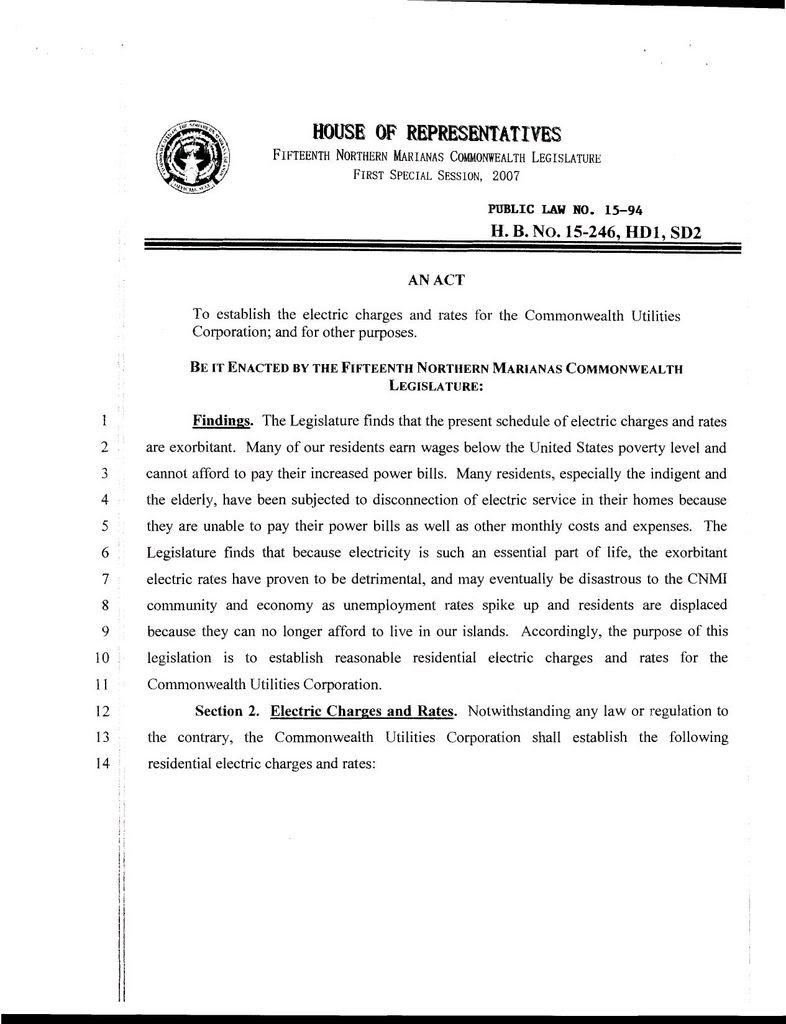
THE Saipan Chamber of Commerce is greatly disappointed with the legislature’s recent override of Governor Fitial’s veto of H.B. 15-246. The legislators’ transparent election year move to gain votes cannot be ignored. In the absence of any credible and well-reasoned explanation for both the initial passage, and subsequent veto override, of H.B. 15-246, we must assume that this is an unfortunate example of election-year pandering to the electorate. How can lawmakers believe this is any solution? CUC has clearly explained the consequences of such an override: the utility will be unable to pay its fuel bill, thus assuring regular black outs. CUC estimates 60 days of blackouts in a year, because of inability to pay for fuel. That equates to four hours a day, every day, for a year. And our elected officials have ignored this warning, to the detriment of us all. Our power crisis did not occur overnight and neither will it be quickly resolved. It is the legislators’ job, along with the administration and CUC, to work through the problem (which has been around for years), not to brush it aside. CUC and the administration had made the hard decision to charge the businesses and residents what it cost to produce power. No one, including chamber members, is happy with higher power rates, but we understand that a business cannot sell a service or product below its cost and expect to pay its bills and staff. We do not expect CUC to do this either. In fact, the Legislature doesn’t really expect this. The legislation provides that “the electric fuel rates may fluctuate depending on the actual cost of fuel.” Isn’t that what was happening already? This is not to excuse CUC. There are many steps they must take to reduce the costs of operations. CUC should be given realistic performance and operating goals and should be required to meet them. But the fact remains that they cannot sell a kilowatt hour for less than the actual cost of a kilowatt hour and still remain viable. And we must have reliable power on this island, for the health and safety of our residents, as well as to provide the backbone for business and future investments. If the Legislature believes that CUC is overstaffed or mismanaged, then they should address the real issue, not the symptom, which is the high cost. If they do not believe that mismanagement or overstaffing is the problem, then they should explain to all of us how they expect CUC to continue its operations while losing money on every kilowatt hour of electricity sold, and with a massive and seriously overdue government receivable on its books. CUC must, unfortunately, adapt to legislative meddling and become creative about how best to provide consistent power even as our elected officials play election year games. The chamber notes that H.B. 15-246 only addresses residential power rates. We suggest that CUC immediately increase its government power rates in an amount sufficient to offset the losses that will be incurred because of this legislation. Then there will be no need for rolling blackouts of any sort, and no “exorbitant” (to use the legislators’ word) residential rates. Reducing CUC rates may appear to assist the people, but this is a case of “penny wise, dollar foolish.” It is a short-sighted fix that will actually hurt people financially in the long-run. Consistent blackouts will force businesses, government offices and schools to close, reduce hours of operation, and reduce staffing. Many employees can expect reduced hours, reduced wages, and the possibility of further businesses closing. Thus, people now trying to make ends meet will become unemployed. Regular power outages will have a negative impact on our tourist industry. And closer to home, power outages damage and shorten the lifespan of electrical appliances. The Legislature wants businesses to hire more local workers, and the chamber supports this effort wholeheartedly. However, legislation such as this only hurts the ability of businesses to retain their current employees, let alone hire more staff. This override also sends the wrong message to potential investors, who look to a community’s ability to provide consistent utilities as a major consideration. The chamber is keenly aware of the hardships Saipan residents are experiencing due to the increase in CUC rates. Businesses are facing the same hardships. It is the duty of our elected officials to provide a reliable infrastructure for the CNMI. Bringing CUC up to efficient and effective operating standards will not be an easy task, but our legislators and administration must do the necessary hard work. We do not want a shoddy “band-aid” approach that is only undertaken to get votes. We are tired of excuses and we are tired of empty promises. We want substance, a real effort, and action to fix this problem. The Saipan Chamber of Commerce supports CUC rates that reflect the actual cost of producing electricity. The chamber also believes that it is long past the time for CUC problems to be faced honestly, and for the administration to take whatever steps are necessary to provide a reliable power infrastructure for the CNMI, starting immediately.JUAN T. GUERRERO PresidentSaipan Chamber of CommerceLawmakers defend CUC bill override
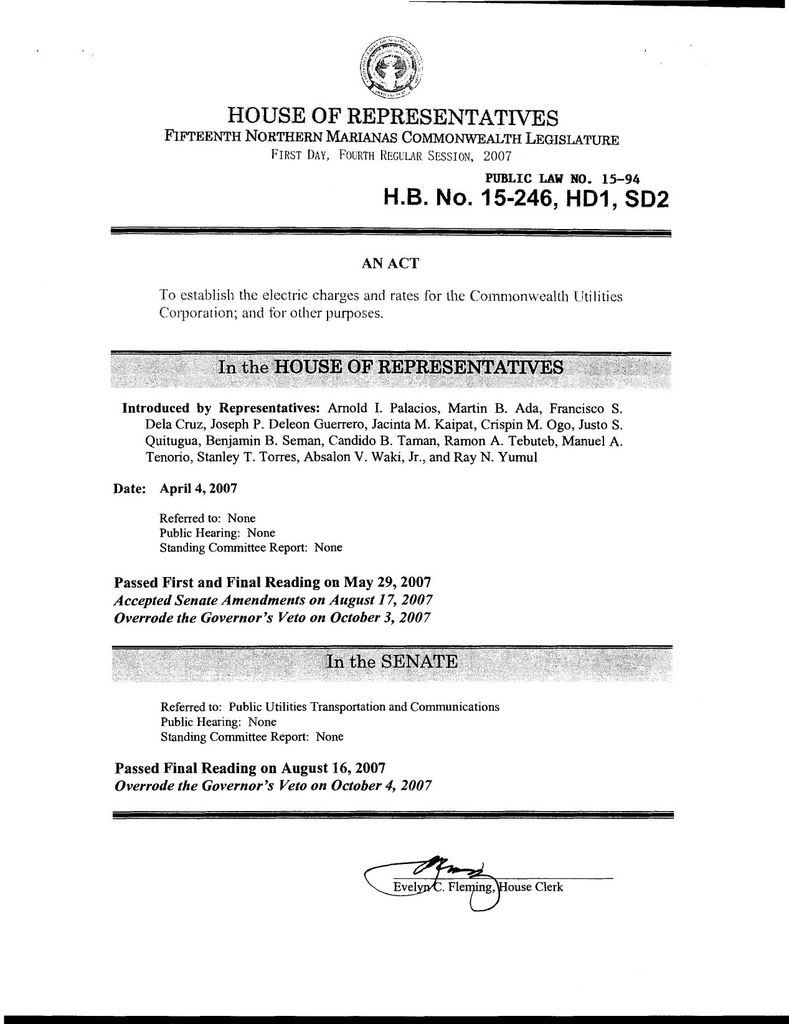
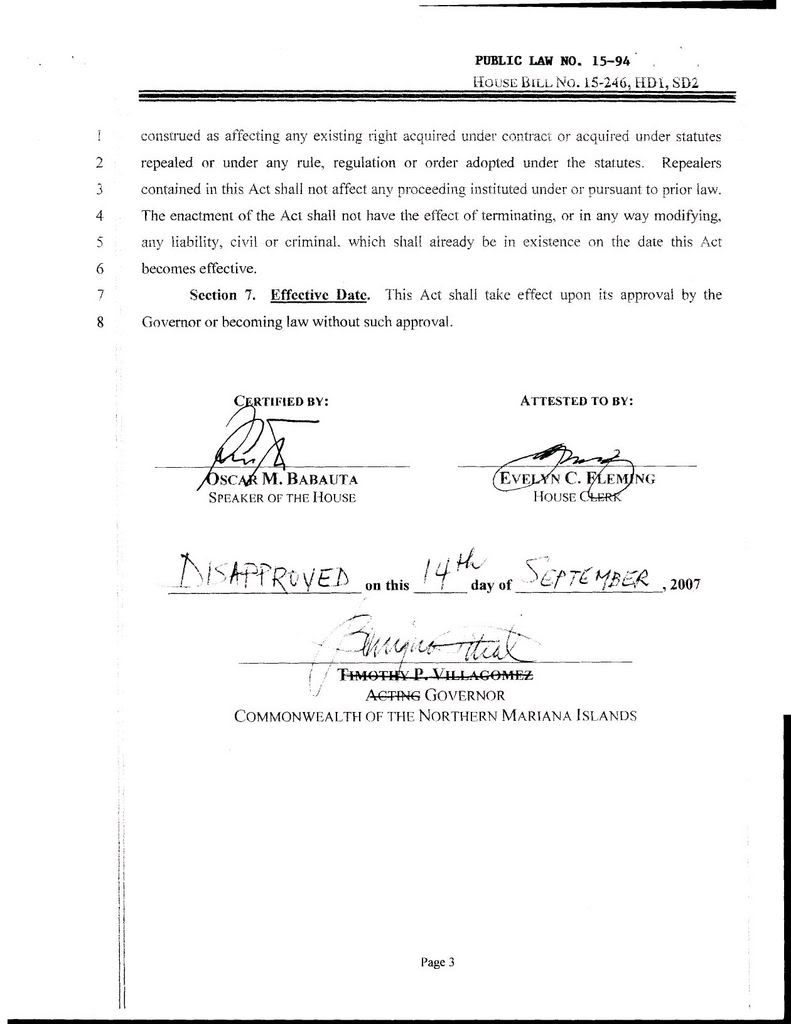
TWO House lawmakers say election year has nothing to do with their decision to override the governor’s veto of a bill lowering residential electric rates. The new law, according to the Commonwealth Utilities Corp., could mean more blackouts in the months ahead if their projected revenue loss of more than $8 million is not replenished.Vice Speaker Justo S. Quitugua, D-Saipan, said CUC’s “scare tactics” are already underway.“The power outages have begun even before we reduced the rates,” he said.Quitugua and House Minority Leader Arnold I. Palacios, R-Saipan, said while it is true that the override came just barely a month before the Nov. 3 midterm elections, it wasn’t intentional and that they worked on the measure as early as last year.“There is no electioneering here. We gave the administration time to decide on this issue,” Palacios said, adding that they were hoping that the administration would be able to form a board for the Public Utilities Commission, but this has yet to happenPress Secretary Charles P. Reyes Jr., who earlier asked the Legislature not to politicize the issue of electric rates, said the people will have to decide on Nov. 3.Palacios, the principal author of the bill, H.B. 15-246, introduced it on April 4.The House passed it on May 29 and the Senate on Aug. 16.On Sept. 14, Governor Benigno R. Fitial vetoed the bill, saying it would further destabilize CUC’s financial situation.He noted that the bill will only benefit residential customers and not the government or commercial establishments.Palacios said he was told that CUC’s budget for fiscal year 2008 will reach $117 million. Of this amount, he said $15 million will go to personnel expense and the rest to its operations budget, including fuel purchases.However, he said CUC hasn’t been able to submit to the Legislature any breakdown of its proposed budget.“The CUC management must give a proper account of how it spends it earnings,” said Palacios. “It’s not on fuel alone that they spend so much. They keep on hiring consultants. We don’t know how much these consultants are getting paid.”“They have order parts as far back as six years ago and some of those parts haven’t arrived yet. No one is making them accountable for their actions,” he added.According to Palacios, CUC hired at least four consultants in recent months including the Philippine-based Delgado & Associates, Quantum Consultants based in the U.S. and Economists.com, which is also based in the U.S.Palacios said CUC should be more transparent in its dealings and not just blame its financial problems on the rising cost of imported fuel.
THE Saipan Chamber of Commerce is greatly disappointed with the legislature’s recent override of Governor Fitial’s veto of H.B. 15-246. The legislators’ transparent election year move to gain votes cannot be ignored. In the absence of any credible and well-reasoned explanation for both the initial passage, and subsequent veto override, of H.B. 15-246, we must assume that this is an unfortunate example of election-year pandering to the electorate. How can lawmakers believe this is any solution? CUC has clearly explained the consequences of such an override: the utility will be unable to pay its fuel bill, thus assuring regular black outs. CUC estimates 60 days of blackouts in a year, because of inability to pay for fuel. That equates to four hours a day, every day, for a year. And our elected officials have ignored this warning, to the detriment of us all. Our power crisis did not occur overnight and neither will it be quickly resolved. It is the legislators’ job, along with the administration and CUC, to work through the problem (which has been around for years), not to brush it aside. CUC and the administration had made the hard decision to charge the businesses and residents what it cost to produce power. No one, including chamber members, is happy with higher power rates, but we understand that a business cannot sell a service or product below its cost and expect to pay its bills and staff. We do not expect CUC to do this either. In fact, the Legislature doesn’t really expect this. The legislation provides that “the electric fuel rates may fluctuate depending on the actual cost of fuel.” Isn’t that what was happening already? This is not to excuse CUC. There are many steps they must take to reduce the costs of operations. CUC should be given realistic performance and operating goals and should be required to meet them. But the fact remains that they cannot sell a kilowatt hour for less than the actual cost of a kilowatt hour and still remain viable. And we must have reliable power on this island, for the health and safety of our residents, as well as to provide the backbone for business and future investments. If the Legislature believes that CUC is overstaffed or mismanaged, then they should address the real issue, not the symptom, which is the high cost. If they do not believe that mismanagement or overstaffing is the problem, then they should explain to all of us how they expect CUC to continue its operations while losing money on every kilowatt hour of electricity sold, and with a massive and seriously overdue government receivable on its books. CUC must, unfortunately, adapt to legislative meddling and become creative about how best to provide consistent power even as our elected officials play election year games. The chamber notes that H.B. 15-246 only addresses residential power rates. We suggest that CUC immediately increase its government power rates in an amount sufficient to offset the losses that will be incurred because of this legislation. Then there will be no need for rolling blackouts of any sort, and no “exorbitant” (to use the legislators’ word) residential rates. Reducing CUC rates may appear to assist the people, but this is a case of “penny wise, dollar foolish.” It is a short-sighted fix that will actually hurt people financially in the long-run. Consistent blackouts will force businesses, government offices and schools to close, reduce hours of operation, and reduce staffing. Many employees can expect reduced hours, reduced wages, and the possibility of further businesses closing. Thus, people now trying to make ends meet will become unemployed. Regular power outages will have a negative impact on our tourist industry. And closer to home, power outages damage and shorten the lifespan of electrical appliances. The Legislature wants businesses to hire more local workers, and the chamber supports this effort wholeheartedly. However, legislation such as this only hurts the ability of businesses to retain their current employees, let alone hire more staff. This override also sends the wrong message to potential investors, who look to a community’s ability to provide consistent utilities as a major consideration. The chamber is keenly aware of the hardships Saipan residents are experiencing due to the increase in CUC rates. Businesses are facing the same hardships. It is the duty of our elected officials to provide a reliable infrastructure for the CNMI. Bringing CUC up to efficient and effective operating standards will not be an easy task, but our legislators and administration must do the necessary hard work. We do not want a shoddy “band-aid” approach that is only undertaken to get votes. We are tired of excuses and we are tired of empty promises. We want substance, a real effort, and action to fix this problem. The Saipan Chamber of Commerce supports CUC rates that reflect the actual cost of producing electricity. The chamber also believes that it is long past the time for CUC problems to be faced honestly, and for the administration to take whatever steps are necessary to provide a reliable power infrastructure for the CNMI, starting immediately.JUAN T. GUERRERO PresidentSaipan Chamber of CommerceLawmakers defend CUC bill override
TWO House lawmakers say election year has nothing to do with their decision to override the governor’s veto of a bill lowering residential electric rates. The new law, according to the Commonwealth Utilities Corp., could mean more blackouts in the months ahead if their projected revenue loss of more than $8 million is not replenished.Vice Speaker Justo S. Quitugua, D-Saipan, said CUC’s “scare tactics” are already underway.“The power outages have begun even before we reduced the rates,” he said.Quitugua and House Minority Leader Arnold I. Palacios, R-Saipan, said while it is true that the override came just barely a month before the Nov. 3 midterm elections, it wasn’t intentional and that they worked on the measure as early as last year.“There is no electioneering here. We gave the administration time to decide on this issue,” Palacios said, adding that they were hoping that the administration would be able to form a board for the Public Utilities Commission, but this has yet to happenPress Secretary Charles P. Reyes Jr., who earlier asked the Legislature not to politicize the issue of electric rates, said the people will have to decide on Nov. 3.Palacios, the principal author of the bill, H.B. 15-246, introduced it on April 4.The House passed it on May 29 and the Senate on Aug. 16.On Sept. 14, Governor Benigno R. Fitial vetoed the bill, saying it would further destabilize CUC’s financial situation.He noted that the bill will only benefit residential customers and not the government or commercial establishments.Palacios said he was told that CUC’s budget for fiscal year 2008 will reach $117 million. Of this amount, he said $15 million will go to personnel expense and the rest to its operations budget, including fuel purchases.However, he said CUC hasn’t been able to submit to the Legislature any breakdown of its proposed budget.“The CUC management must give a proper account of how it spends it earnings,” said Palacios. “It’s not on fuel alone that they spend so much. They keep on hiring consultants. We don’t know how much these consultants are getting paid.”“They have order parts as far back as six years ago and some of those parts haven’t arrived yet. No one is making them accountable for their actions,” he added.According to Palacios, CUC hired at least four consultants in recent months including the Philippine-based Delgado & Associates, Quantum Consultants based in the U.S. and Economists.com, which is also based in the U.S.Palacios said CUC should be more transparent in its dealings and not just blame its financial problems on the rising cost of imported fuel.
House seeks 2yr moratorium on the sale of scrap copper wire
By Emmanuel T. EredianoVariety News Staff
AS the Division of Customs Service holds a number of container vans loaded with scrap metal for outbound shipment, the House Committee on Commerce and Tourism is seeking to stop the purchase and sale of scrap copper wire in the CNMI for two years.The House committee chaired by Rep. Martin B. Ada recommended “that House Bill 15-302 be passed.”The purpose of the bill, the committee said in its report on October 3, “is to place a two-year moratorium on the sale and purchase of after-market copper wire in the commonwealth,”A 14-foot container van containing scrap metal remains sitting at the port as Custom is scrutinizing every bit of scrap metal following the recovery of undeclared copper wire last month.Acting Customs Director Gregorio M. Sablan Jr. said in an interview that they have already come up with standard operating procedures in the flow of scrap metal for shipments, which he described to be “a mirror image,” of how it is being done in connection with garments and other shipments that require excise tax.Sablan, however, said that they are still waiting for the Attorney General’s Office to approve their procedures and the secretary of Finance to give them instructions. Rep. Ray N.Yumul, Ind.-Saipan in a separate interview said H.B. 15-302 “is to improve the intent of P.L. 15-36 and P.L. 15-55.P.L. 15-36, or the Recycling Reporting Act, regulates the recycling business in the CNMI while P.L. 15-55 provides 45-day waiting period for recycled materials leaving the islands.H.B. 15-302, the committee report said, also requires recycling businesses to apply for a business license at the Department of Commerce for an annual fee of $500. On October 2, customs authorities discovered a large quantity of copper wire embedded in compacted scrap metal for outbound shipment The 20-foot container van belongs to Saipan Triple Star Recycling Inc.Sablan declined to say more about it as the case is still under investigation. Yumul said he is very disappointed that while some recyclers are trying to make a clean living out of garbage, others are doing it dirty by buying stolen items.“And the honest firms are being tainted due to these shady operators,” he said.The lawmaker also said he is glad that the CNMI government has “a good handle on copper wire theft issues,”He commended Customs and the Department of Public Safety for doing the best they can to curb these thefts.
AS the Division of Customs Service holds a number of container vans loaded with scrap metal for outbound shipment, the House Committee on Commerce and Tourism is seeking to stop the purchase and sale of scrap copper wire in the CNMI for two years.The House committee chaired by Rep. Martin B. Ada recommended “that House Bill 15-302 be passed.”The purpose of the bill, the committee said in its report on October 3, “is to place a two-year moratorium on the sale and purchase of after-market copper wire in the commonwealth,”A 14-foot container van containing scrap metal remains sitting at the port as Custom is scrutinizing every bit of scrap metal following the recovery of undeclared copper wire last month.Acting Customs Director Gregorio M. Sablan Jr. said in an interview that they have already come up with standard operating procedures in the flow of scrap metal for shipments, which he described to be “a mirror image,” of how it is being done in connection with garments and other shipments that require excise tax.Sablan, however, said that they are still waiting for the Attorney General’s Office to approve their procedures and the secretary of Finance to give them instructions. Rep. Ray N.Yumul, Ind.-Saipan in a separate interview said H.B. 15-302 “is to improve the intent of P.L. 15-36 and P.L. 15-55.P.L. 15-36, or the Recycling Reporting Act, regulates the recycling business in the CNMI while P.L. 15-55 provides 45-day waiting period for recycled materials leaving the islands.H.B. 15-302, the committee report said, also requires recycling businesses to apply for a business license at the Department of Commerce for an annual fee of $500. On October 2, customs authorities discovered a large quantity of copper wire embedded in compacted scrap metal for outbound shipment The 20-foot container van belongs to Saipan Triple Star Recycling Inc.Sablan declined to say more about it as the case is still under investigation. Yumul said he is very disappointed that while some recyclers are trying to make a clean living out of garbage, others are doing it dirty by buying stolen items.“And the honest firms are being tainted due to these shady operators,” he said.The lawmaker also said he is glad that the CNMI government has “a good handle on copper wire theft issues,”He commended Customs and the Department of Public Safety for doing the best they can to curb these thefts.
Wednesday, October 31, 2007
Businesses, gov’t to pay record high power rates
mv 110107
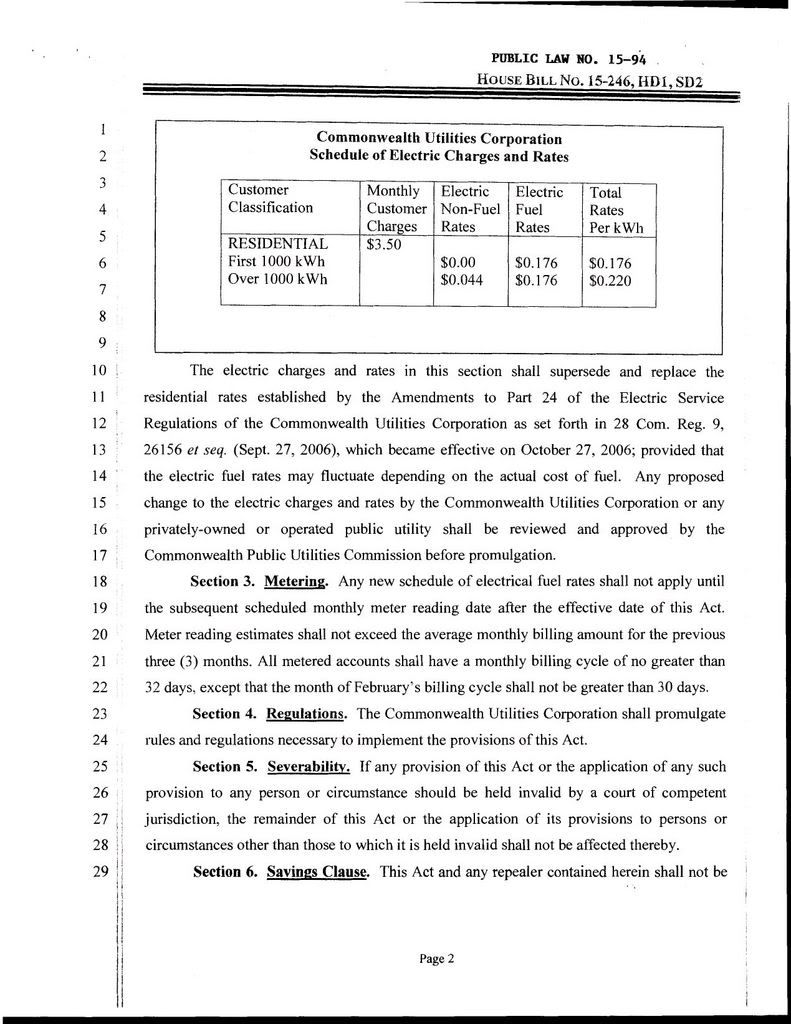
THE government and the business sector will pay record high rates for their electricity this month as the prices of imported fuel sold to the Commonwealth Utilities Corp. for its power plants and water wells reached more than $100 a barrel late last month.This month, CUC will charge the business sector 34.4 cents per kilowatt hour, up from 31.4 cents last month.The government will be charged 34.9 cents per kwh this month, up from 31.9 cents in October.Residential customers would have been charged anywhere from 27.4 to 38.5 cents per kwh had the lawmakers not overridden Gov. Benigno R. Fitial’s veto of a measure reducing the residential electric rates to 17.6 cents per kwh for the first 1,000 kwh of energy they consume.Pamela Mathis, CUC spokeswoman, said in September, they bought fuel from Singapore through Mobil Oil Marianas at $93.55 a barrel or $2.45-$2.90 per gallon.Late last month, the price of fuel sold to CUC hit $100.49 a barrel.“That’s the highest cost per barrel in CUC/CNMI history,” said Mathis.She said CUC is still trying to figure out how to address the huge projected revenue loss due to reduced residential electric rates which involves close to 12,000 accounts.A bill has been introduced in the House of Representatives to provide CUC with up to $6 million in fuel subsidies. But Mathis said the amount may not be enough since CUC’s projected revenue shortfall is more than $8 million.She said the current cap on residential electric rates can still be altered through the governor’s emergency powers, which he hasn’t exercised yet.
THE government and the business sector will pay record high rates for their electricity this month as the prices of imported fuel sold to the Commonwealth Utilities Corp. for its power plants and water wells reached more than $100 a barrel late last month.This month, CUC will charge the business sector 34.4 cents per kilowatt hour, up from 31.4 cents last month.The government will be charged 34.9 cents per kwh this month, up from 31.9 cents in October.Residential customers would have been charged anywhere from 27.4 to 38.5 cents per kwh had the lawmakers not overridden Gov. Benigno R. Fitial’s veto of a measure reducing the residential electric rates to 17.6 cents per kwh for the first 1,000 kwh of energy they consume.Pamela Mathis, CUC spokeswoman, said in September, they bought fuel from Singapore through Mobil Oil Marianas at $93.55 a barrel or $2.45-$2.90 per gallon.Late last month, the price of fuel sold to CUC hit $100.49 a barrel.“That’s the highest cost per barrel in CUC/CNMI history,” said Mathis.She said CUC is still trying to figure out how to address the huge projected revenue loss due to reduced residential electric rates which involves close to 12,000 accounts.A bill has been introduced in the House of Representatives to provide CUC with up to $6 million in fuel subsidies. But Mathis said the amount may not be enough since CUC’s projected revenue shortfall is more than $8 million.She said the current cap on residential electric rates can still be altered through the governor’s emergency powers, which he hasn’t exercised yet.
Tuesday, October 30, 2007
CUC lifts emergency load shedding
By Gemma Q. CasasVariety News Staff 103107
THE Commonwealth Utilities Corp. yesterday canceled its emergency load shedding schedule after its mechanics successfully fixed the troubled 7-megawatt engine, raising to four the number of working generators at Saipan’s main source of electricity.Pamela Mathis, CUC spokeswoman, said the troubled engine underwent a hydro-test and its leaks were also repaired.That engine’s leak problems with its cylinder caused its water and oil to mix.“So they have to reseal the cylinder,” Mathis said. “They also drained from the engine all of the contaminated oil that has a mixture of water in it.”After the engine was drained of all the liquids, the repair was made.Mathis said a group of in-house CUC power plant staff mechanics fixed the engine on a 12-hour rotating shift.“Four men and one foreman have been working since Friday on this engine on a 12-hour rotating basis,” she said. She said the other engines, which also experienced trouble from time to time, will undergo repair maintenance once the parts they have ordered arrived.In the meantime, CUC is reiterating its call on residents and commercial establishments to conserve as much energy as they can to help the agency keep up with the electricity demand of the island.Mathis said CUC noticed an upsurge on the use of electricity among residential customers after the Legislature’s override on a vetoed bill lowering residential electric rates.
THE Commonwealth Utilities Corp. yesterday canceled its emergency load shedding schedule after its mechanics successfully fixed the troubled 7-megawatt engine, raising to four the number of working generators at Saipan’s main source of electricity.Pamela Mathis, CUC spokeswoman, said the troubled engine underwent a hydro-test and its leaks were also repaired.That engine’s leak problems with its cylinder caused its water and oil to mix.“So they have to reseal the cylinder,” Mathis said. “They also drained from the engine all of the contaminated oil that has a mixture of water in it.”After the engine was drained of all the liquids, the repair was made.Mathis said a group of in-house CUC power plant staff mechanics fixed the engine on a 12-hour rotating shift.“Four men and one foreman have been working since Friday on this engine on a 12-hour rotating basis,” she said. She said the other engines, which also experienced trouble from time to time, will undergo repair maintenance once the parts they have ordered arrived.In the meantime, CUC is reiterating its call on residents and commercial establishments to conserve as much energy as they can to help the agency keep up with the electricity demand of the island.Mathis said CUC noticed an upsurge on the use of electricity among residential customers after the Legislature’s override on a vetoed bill lowering residential electric rates.
Subscribe to:
Posts (Atom)

TAOTAO TANO PROPOSAL PAGE 1

TAOTAO TANO PROPOSAL PAGE 2

 Visits